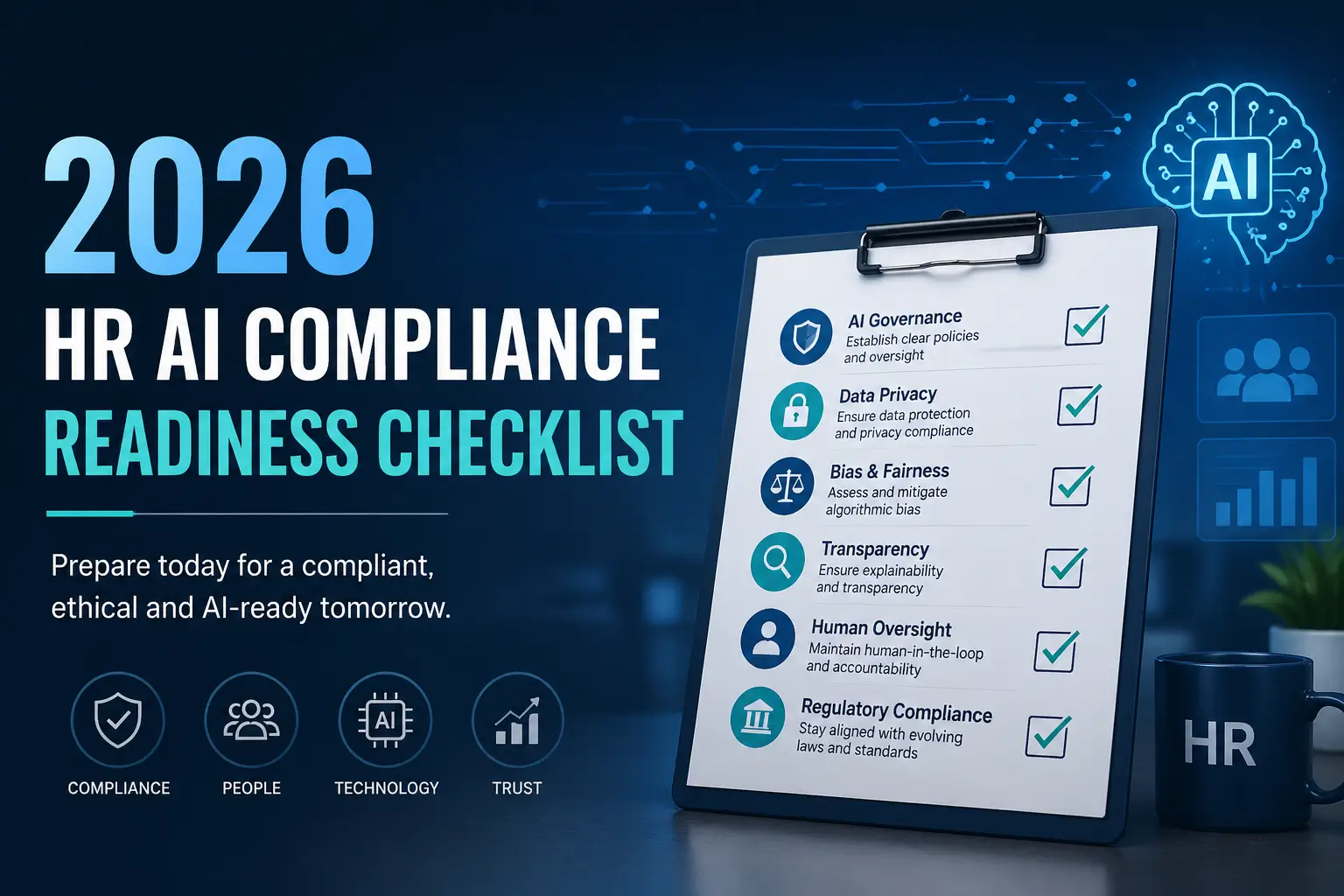
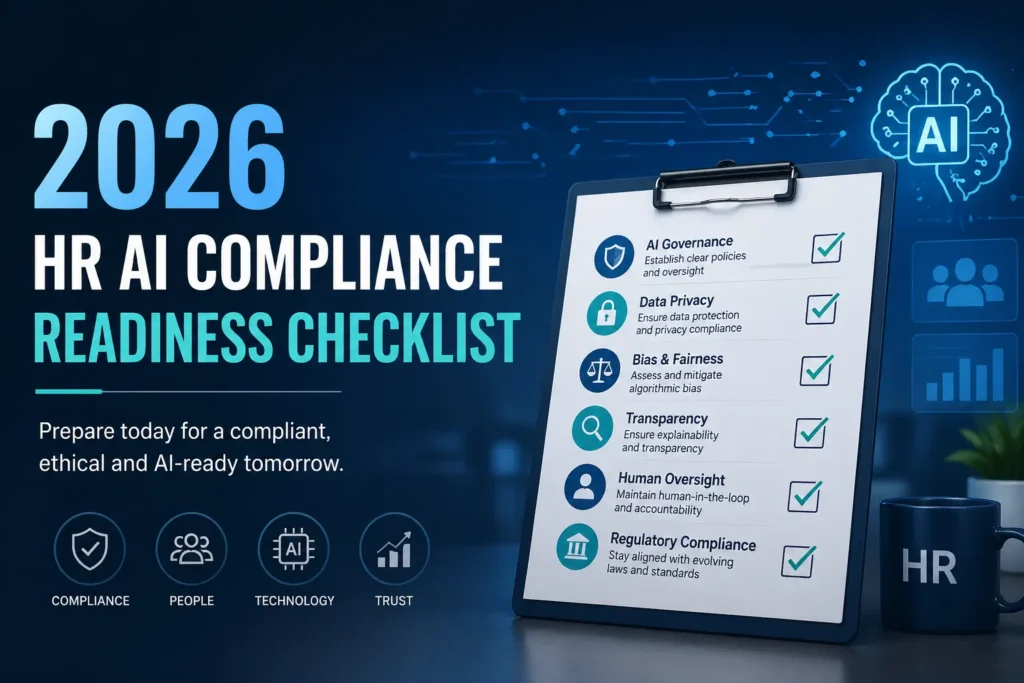
2026 HR AI Compliance Readiness Checklist Template
Free Downloadable PDF for Non-Tech HR Teams
The No-Code Way to Stay Audit-Ready Without Tech Headaches
Brought to you by The Non-Tech AI – your go-to place for jargon-free AI that actually helps HR teams.
Why this checklist?
2026 is here, and the rules are getting stricter: EU AI Act deadlines, new state privacy laws, bias audit requirements, and endless regulator questions. Most HR teams are still doing this manually with spreadsheets and crossed fingers.
This checklist helps you quickly score where you stand, spot the biggest gaps, and build a simple no-code plan, all in under 15 minutes. No tech degree required.
How to use it:
- Answer each section honestly.
- Score yourself at the end.
- Follow the “Next 30-Day Action Plan” to start fixing things.
- Come back to this checklist every quarter.
Print it, fill it out digitally, or share it with your team.
Section 1: Quick Self-Assessment (Score Your Current State)
Rate each statement 1–5 (1 = “Not at all,” 5 = “We’re crushing it”).
Policy & Documentation
☐ We have up-to-date HR policies that are easy for AI to read and enforce.
☐ Every policy change is automatically logged with who approved it and when.
☐ New hires automatically acknowledge policies during onboarding.
Bias & Fair Hiring
☐ We run regular checks on job descriptions, interview questions, and promotion decisions for hidden bias.
☐ Our ATS or screening tools explain every decision in plain English (required for EU AI Act & NYC Local Law 144).
☐ We track demographic outcomes in hiring/promotions without manual spreadsheets.
Data Privacy & Security
☐ Employee data is automatically flagged if it’s stored longer than needed (GDPR/CCPA rules).
☐ We have consent tracking for any AI tools that touch personal data.
☐ Audit-ready reports can be generated in one click.
Audits & Monitoring
☐ We have continuous monitoring (not just once-a-year audits).
☐ AI alerts us before a compliance problem happens.
☐ Payroll, tax, and classification decisions are automatically double-checked.
Training & Accountability
☐ Compliance training is automatically assigned and tracked.
☐ Every AI tool we use has human oversight and approval steps built in.
☐ Leadership gets a simple monthly “compliance health” dashboard.
Total Score: _____ / 75
- 60–75 = Strong – you’re ahead of most teams. Use the advanced tips below.
- 40–59 = Good start – focus on the red items in Section 3.
- Below 40 = High risk – start with the 30-day plan today.
Section 2: Must-Have No-Code AI Features Checklist
Tick the boxes for the features your current tools already have. The more green checks, the better.
✅ Automatic audit logging (every decision recorded)
✅ Real-time policy violation alerts
✅ Built-in bias detection for hiring/promotions
✅ Auto-updates for new laws (EU AI Act, state privacy rules, etc.)
✅ Human-in-the-loop approvals (AI suggests, you approve)
✅ Plain-English explanations for every AI decision
✅ Easy integration with your existing HRIS/ATS/payroll (no coding)
✅ Secure data handling with SOC 2 / GDPR compliance out of the box
✅ Free or low-cost starter plan for small teams
Pro tip: If you have fewer than 6 green checks, the 7 HR compliance tools from our guide (MindStudio, Everworker.ai, Zapier, etc.) can fill those gaps fast.
Section 3: Red Flags That Could Get You in Trouble in 2026
Check any that still apply to you:
☐ Still using spreadsheets for compliance tracking
☐ No explanation for why AI rejected a candidate
☐ Employee data is stored “just in case” with no deletion schedule
☐ Compliance is only reviewed once a year
☐ Your AI tools don’t log who changed what and when
☐ You’re guessing about which laws apply to remote/global employees
If you checked 2 or more: Start with the 30-day action plan below. These are the exact issues regulators are focusing on right now.
Section 4: Your 30-Day No-Code Action Plan
☐ Week 1: Pick ONE tool (recommendation: Zapier or Playroll Orbit if you want free) and automate just one painful task (example: auto-log policy acknowledgments).
☐ Week 2: Run your first bias check on job descriptions and interview questions.
☐ Week 3: Set up basic audit logging for at least one HR process.
☐ Week 4: Create a one-page “compliance health” report for leadership and schedule a recurring check.
Bonus resources included with this checklist:
- Prompt templates you can copy-paste into any no-code AI tool
- Quick comparison of the 7 best tools we reviewed
- Link to our full “AI for HR Compliance in 2026” pillar guide
You did it!
You now have a clear picture of your 2026 HR AI compliance readiness.
Next step:
Head back to The Non-Tech AI and grab the full no-code guide + tool roundups. Or reply to this email with your biggest gap — I’m happy to help you pick the right starting tool.
Stay compliant, stay human, and keep making HR easier.
Jenna Clark
The Non-Tech AI
P.S. Update this checklist every 90 days. The rules will keep changing, but your no-code setup will make it simple.
Frequently Asked Questions
Regulations emphasize transparency and nondiscrimination, requiring organizations to prove that AI tools do not produce discriminatory outcomes.
Many high-risk AI applications (including recruitment) must meet strict requirements by August 2026 under the EU AI Act.
Auditors require logs of all AI changes, data sheets, risk assessments, and evidence of human oversight.
No, the use of AI for emotion recognition during interviews is prohibited.
The highest risk is using black box algorithms that cannot be explained or validated for bias.
Audit current AI tools (resumes, assessments, performance management) for bias and impact, and establish a formal AI governance policy that defines ownership, human oversight, and documentation standards.
Ensure all AI vendors provide documentation explaining how their algorithms work and that the system allows for human review/override of AI decisions.
Yes, many jurisdictions now require disclosures, particularly if AI tools make or significantly influence hiring decisions.
Maintain records of AI validation tests, audit trails, and data processing activities. Ensure documentation of vendor compliance with EEOC guidelines.
AI-driven recruitment, resume screening, candidate assessments, and automated employee monitoring tools are considered highest risk due to emerging state-level legislation.
By auditing what employee data is collected, implementing encryption, and ensuring compliance with regulations like California’s CCPA/CPRA, including proper notices for automated decision-making technologies (ADMT).