(AI Recruiting Tools Updated February 28, 2026 – Agentic AI edition)
Recruiting in 2026 is defined by agentic AI—autonomous agents that source candidates from vast datasets, personalize outreach, screen in real time, schedule interviews, and handle follow-ups with minimal manual input.
Leading reports and vendor benchmarks show these tools can cut time-to-hire by 30–80%, boost candidate engagement, and improve quality metrics when governance (bias mitigation, explainability, audit trails) is strong.
This post ranks the top 10 AI recruiting tools for 2026 based on current traction, features, integrations (ATS like Workday, Greenhouse, Lever), and real outcomes from sources like Metaview, Humanly, Juicebox, Joveo, Recruiterflow, and more. Focus is on agentic capabilities, compliance readiness, and measurable ROI. No fluff or outdated hype.
Quick Comparison Table: Top AI Recruiting Tools 2026
| Rank | Tool | Best For | Agentic Level | Key 2026 Strength | Pricing Signal | Ideal For |
|---|---|---|---|---|---|---|
| 1 | Juicebox.ai | Orchestration & autonomous sourcing | High | Natural language PeopleGPT search + workflow governance across sourcing to scheduling | Free tier / 99–129+/mo | Growth & mid-market teams |
| 2 | Paradox (Olivia) | High-volume conversational hiring | High | 24/7 chat-based screening, scheduling & engagement in 100+ languages | Quote-based / Per module | High-volume & enterprise |
| 3 | HireVue | Structured video interviews & assessments | Medium-High | AI scoring with bias controls from 30M+ interviews | Enterprise custom (~35k–100k+/yr) | Large-scale structured hiring |
| 4 | Eightfold AI | Skills-based talent intelligence | High | Matching on skills/potential + internal mobility | ~$7–10/employee/mo | Enterprise & skills-first |
| 5 | hireEZ | Broad AI sourcing & outreach | High | Search across 650M+ profiles + automated sequences | Quote-based | Mid-to-large sourcing-heavy |
| 6 | Humanly | Unified screening & interviews | High | Conversational AI with audit-ready records & recruiter control | Quote-based | Scaling & compliant teams |
| 7 | SeekOut | Passive & niche talent discovery | High | Agentic sourcing from diverse sources | Quote-based | Tech/niche/hard-to-fill roles |
| 8 | Metaview | Interview intelligence & notes | Medium-High | AI agents for insights, decision quality & candidate experience | Quote-based | Modern TA workflows |
| 9 | Workable | Affordable ATS with AI features | Medium | AI matching, job descriptions & video interviews | Starts ~$129/mo | SMBs & startups |
| 10 | Findem / Skima AI | Personalized sourcing & insights | Medium-High | Advanced search for diverse pipelines | Quote-based | Specialized & diversity-focused |
Rankings prioritize 2026 relevance: agentic autonomy, governance/compliance, ROI speed, and consensus from recent guides (e.g., Juicebox orchestration lead, Paradox for volume, Eightfold for skills). Always trial for your stack.
Deep Dives on the Top Contenders
1. Juicebox.ai – Best Overall for Agentic Orchestration in 2026
Juicebox acts as a governance layer connecting sourcing, engagement, screening, and scheduling into autonomous workflows. Recruiters use PeopleGPT (natural language queries like “senior engineers with specific tech stack experience”) to pull from massive profiles, then agents automate personalized outreach and pipeline management with explainability and bias monitoring.
Pros:
- Reduces tool sprawl; strong ATS integrations
- Governance for compliance and measurable KPIs (time-to-slate, offer acceptance)
- Free tier for quick testing
Cons:
- Newer platform; best with some workflow setup
2026 Verdict: Ideal if you want end-to-end agentic recruiting without losing human oversight. Top pick for teams scaling intelligently.
2. Paradox (Olivia) – Best for High-Volume & Candidate Experience
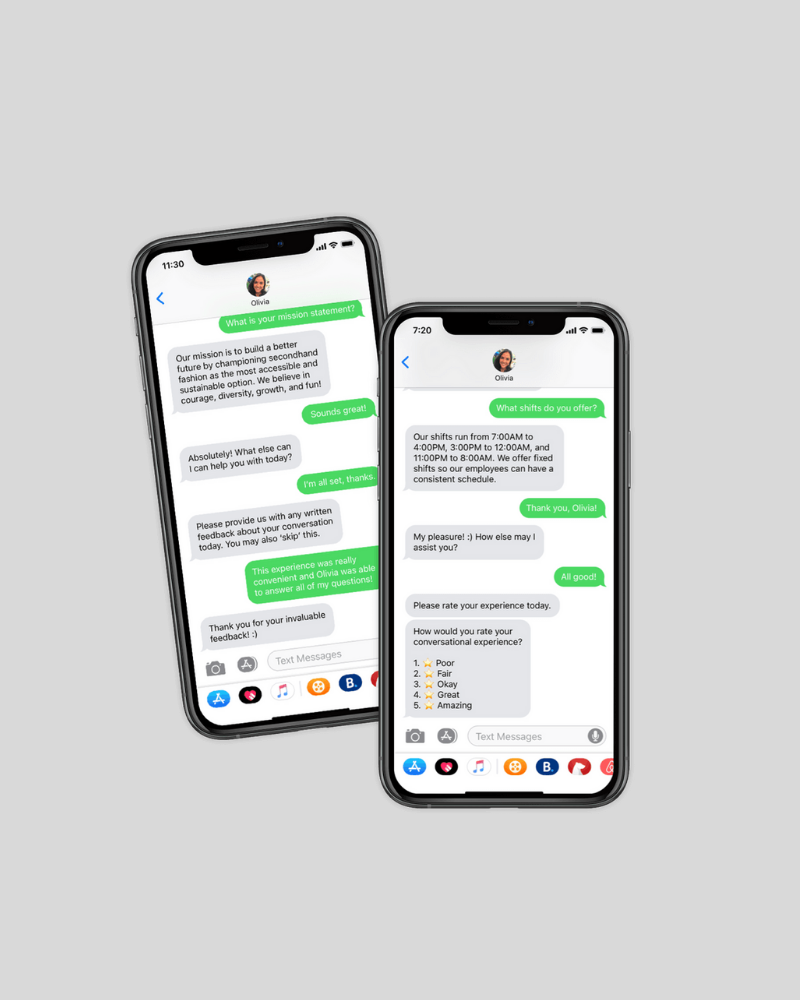
Olivia is a conversational AI superstar, handling screening, qualification, scheduling, and FAQs via text/WhatsApp/website 24/7—automating up to 80% of early funnel tasks.
Pros:
- Massive engagement boosts (300–400% in applications for some users)
- Supports high-volume roles across industries
- Deep integrations with major ATS
Cons:
- Less focus on deep talent intelligence
2026 Verdict: The go-to for continuous, large-scale hiring where speed and candidate satisfaction are critical.
Read the full Paradox AI Software Review for more information.
3. HireVue – Best for Defensible Assessments & Video Interviews
Hirevue AI analyzes video responses for skills, confidence, and fit using a huge dataset, with built-in bias reduction and audit trails for compliance.
Pros:
- Consistent, structured scoring
- Game-based and coding assessments available
- Enterprise-grade integrations
Cons:
- Higher cost; suited for high-stakes roles
2026 Verdict: Excellent for organizations needing standardized, auditable decisions.
Check out our Hirevue HR Software Review for an In-depth breakdown.
4. Eightfold AI – Best for Skills-Based Hiring & Internal Mobility
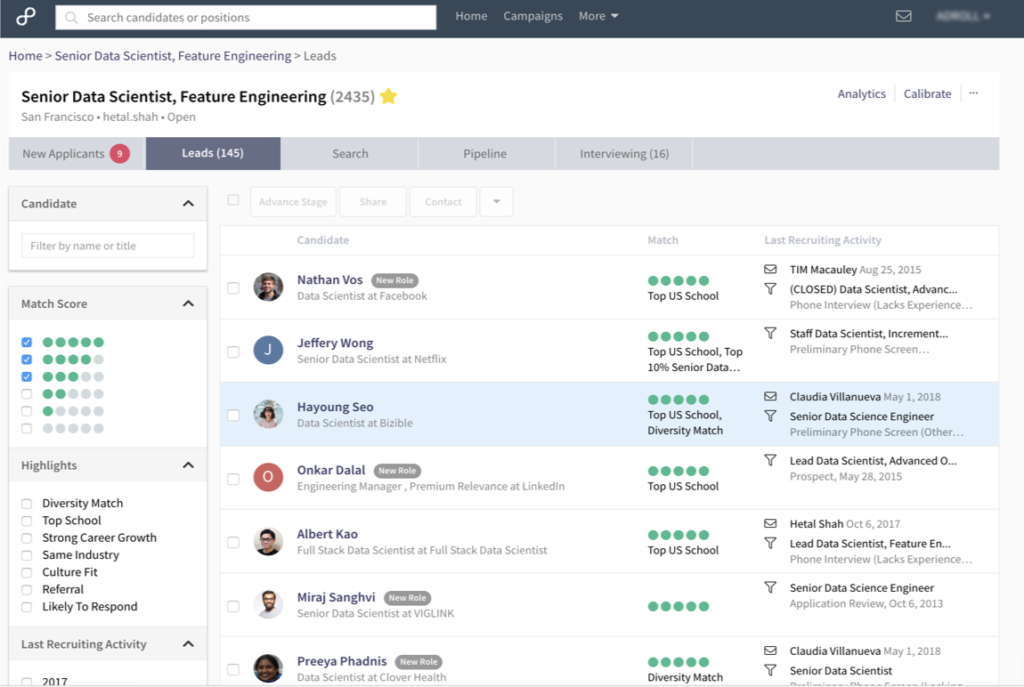
Focuses on skills and potential over resumes, matching candidates to current and future roles while supporting internal talent pipelines.
Pros:
- Reduces bias through transferable skills emphasis
- Workforce planning insights
Cons:
- Enterprise pricing and implementation
2026 Verdict: Perfect for the growing skills-over-degrees trend.
Check out Hirevue vs Eightfold vs Paradox for more in-depth comparisons.
5–10 Quick Overviews of AI Recruiting Tools
- hireEZ: Automated sourcing from 30+ platforms with diversity filters.
- Humanly: Unified conversational platform with strong auditability.
- SeekOut: Agentic discovery for passive and niche talent.
- Metaview: AI turns interviews into actionable notes and insights.
- Workable: Budget-friendly ATS with solid AI for everyday recruiting.
- Findem / Skima AI: Personalized search for building targeted pipelines.
How to Choose & Implement AI Recruiting Tools in 2026
Step-by-step instructions on how to choose and implement AI recruiting tools for HR in 2026
- Map your bottleneck
Sourcing speed? High drop-off? Compliance risks? Skills matching?
- Prioritize agentic + governance
Look for autonomy with explainability and human-in-loop.
- Trial rigorously
Use demos/free tiers on real roles.
- Integrate & scale
Ensure ATS/HRIS fit.
- Measure success
Track time-to-hire, quality-of-hire, diversity metrics.
Red flags: Weak bias controls, no recent updates, or poor transparency.
Frequently Asked Questions
Software platforms that leverage machine learning (ML) and natural language processing (NLP) to automate repetitive tasks like resume parsing, interview scheduling, and candidate ranking.
No. These tools are designed to augment recruiters by handling administrative grunt work, allowing humans to focus on high-value tasks like relationship building, cultural fit assessment, and final hiring decisions.
They lower costs by reducing manual labor hours, improving talent rediscovery (finding qualified candidates already in your database), and shortening the overall time-to-hire.
Yes, if configured correctly. AI can apply standardised evaluation criteria and objective scoring to all candidates, which helps mitigate unconscious human bias.
AI recruiting tools use artificial intelligence to automate and enhance various stages of the hiring process, including sourcing, screening, and candidate engagement.
No. A human-in-the-loop approach is recommended, where AI supports tasks like sourcing and initial screening, but humans handle final decisions, relationship building, and cultural fit.
Start by identifying a specific headache, such as high-volume screening or slow scheduling. It is critical to ensure the tool integrates seamlessly with your existing HR tech stack (CRM, HRIS) to avoid creating manual data silos.
An ATS primarily manages the hiring workflow and stores candidate data. AI recruiting tools enhance this by using machine learning to rank candidates by fit, automate scheduling, and provide predictive analytics.
Regulations like NYC Local Law 144 and the EU AI Act mandate regular bias audits and candidate notifications. Illinois law (effective 2026) specifically requires notifying candidates if AI-powered video interviews are used
AI can sometimes generate plausible but incorrect information. To prevent this, companies must maintain human oversight, use high-quality training data, and conduct regular system audits
Ready to Level Up Your Recruiting?
2026 favors agentic, governed AI—start with Juicebox or Paradox for fast impact, then layer in Eightfold or HireVue for depth. The best stacks combine tools for full coverage.
Check out the ultimate HR AI tool guide for broader context and deeper dive into each tool, and the Cheap AI HR Tools for low-cost AI tool options for small businesses.
What’s your main recruiting challenge right now—sourcing, screening, or something else? Comment below or email me on jenna@thenontechai.com. I’ll share tailored recommendations!
Subscribe for weekly HR AI updates, tool tests, and comparisons.
Sources: February 2026 vendor sites, Metaview, Humanly, Juicebox, Joveo, Recruiterflow, SHRM trends, etc. We conduct our own trials and tool demos.

5 Comments