How to Improve Forecast Accuracy with AI (Practical Guide 2026)
Forecast accuracy is one of the most common frustrations I hear from non-technical professionals. They spend time building projections, only to find that actual results differ significantly from what they expected. Over time, this erodes confidence in the entire planning process.
AI will not make your forecasts perfect. Anyone promising that is overselling. What AI can do is help you systematically reduce common sources of error, test assumptions more rigorously, and learn faster from past misses.
This guide shares practical methods I have seen work, along with patterns observed from real forecasting processes.
Why Forecasts Miss the Mark
From reviewing numerous budgets and forecasts with founders, operators, and finance managers, the same issues appear repeatedly:
- Overly optimistic revenue assumptions
- Underestimated timing gaps between making a sale and collecting cash
- Forgotten or underestimated irregular expenses
- Static assumptions that are never updated
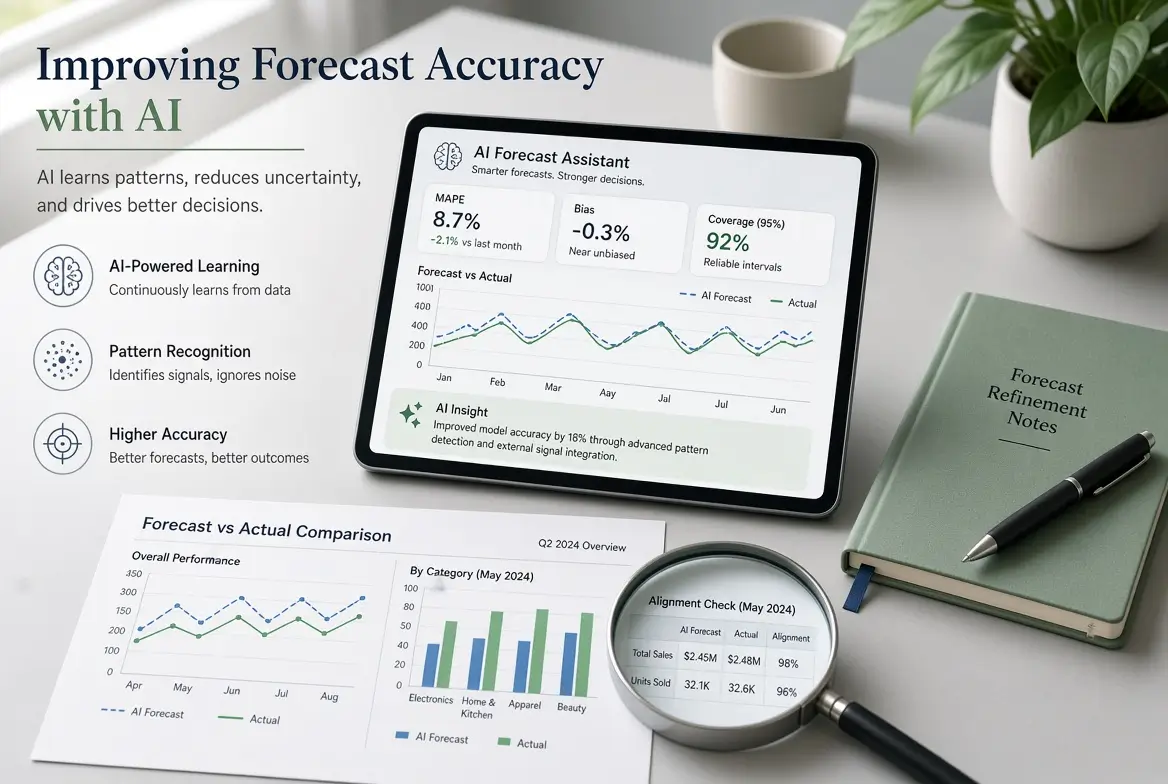
- Lack of comparison between previous forecasts and actual results
Improving accuracy is less about finding a smarter algorithm and more about building better habits and feedback loops. AI supports this when used intentionally.
What “Better Accuracy” Actually Means
In practice, useful forecast accuracy does not mean predicting exact numbers. It means:
- Reducing large, repeated misses
- Improving the reliability of directional outlooks (better/worse than expected)
- Identifying risks earlier
- Making fewer decisions based on unrealistic projections
A forecast that is consistently within a reasonable range and updated with learning is far more valuable than a precise-looking forecast that is frequently wrong.
Practical Ways to Improve Forecast Accuracy with AI
1. Compare Past Forecasts to Actual Results
This is the highest-leverage habit I recommend.
How to do it with AI:
Here is my forecast for the past [3/6/12] months and the actual results.

Forecast:
[Paste]

Actuals:
[Paste]

Analyze the differences. Identify the biggest areas of over- and under-estimation. Highlight recurring patterns and suggest specific assumption changes for future forecasts.
Many people skip this step. Those who do it consistently improve faster than those who simply create new forecasts from scratch each time.
2. Separate Confirmed Numbers from Assumptions
AI can help you structure forecasts so it is clear what is known versus what is estimated.
When confirmed data (signed contracts, fixed costs, scheduled payments) is mixed with optimistic guesses, accuracy suffers. Asking AI to flag assumptions explicitly creates transparency and better discussions.
3. Improve the Quality of Drivers, Not Just the Totals
A common mistake is forecasting revenue as a single top-line number. More accurate forecasts usually break revenue into drivers (for example, number of customers, average value, conversion rates, or seasonal patterns).
AI is useful for helping you identify which drivers matter most and for stress-testing them.
4. Use Scenario Ranges Instead of Single-Point Estimates
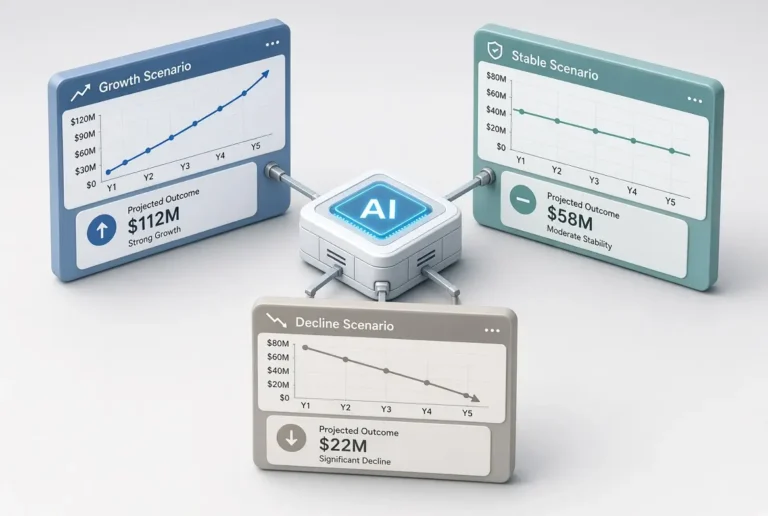
In my experience, teams that present a range (conservative / base / optimistic) make better decisions than those that rely on one “most likely” number. AI makes it fast to generate and compare these ranges.
5. Shorten the Feedback Cycle
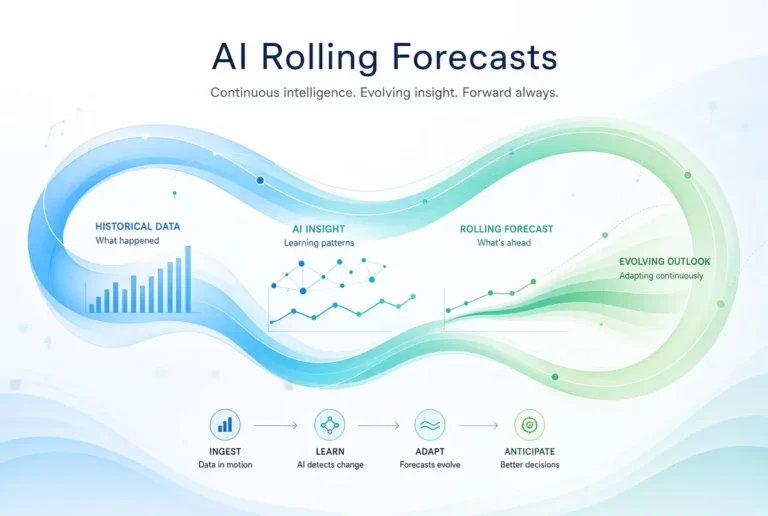
Annual forecasts that are never revisited tend to drift. Monthly or rolling updates, even light ones, significantly improve relevance and accuracy over time. AI reduces the effort required to perform these updates.
Pro Tip: Accuracy Improves Faster Through Post-Mortems Than Through More Complex Models
After observing both simple and sophisticated forecasting approaches, one conclusion stands out: the teams that regularly review why previous forecasts were wrong improve more quickly than teams that invest heavily in complex models but rarely analyze their misses.
AI is particularly effective at accelerating these post-mortems. It can quickly surface patterns across multiple periods that humans might notice only slowly.
Real-World Example
A small professional services firm consistently overestimated monthly revenue by 15–25%. When we ran their previous six forecasts through an AI comparison process, a clear pattern emerged: they were recognizing revenue too early and underestimating project delays.
Once they adjusted the timing assumptions and began forecasting based on likely completion dates rather than signed proposals alone, their next three months of forecasts were significantly closer to reality. No advanced modeling was required. nly better assumptions informed by structured review.
Practical Prompt Library for Accuracy Improvement
Assumption Stress Test:
Review this forecast and list the five assumptions that carry the most risk. For each one, explain how it could be wrong and what early indicators would show that it is drifting.Bias Check:
Analyze this forecast for signs of optimistic bias. Point out any areas that appear aggressive based on the historical data provided.Driver Quality Check:
Evaluate whether this forecast is driven by meaningful business drivers or mostly by high-level estimates. Suggest practical ways to make the drivers more concrete.Limitations and Trust Boundaries
AI can improve structure, speed, and pattern recognition. It cannot:
- Predict sudden market shocks with reliability
- Replace accurate bookkeeping
- Compensate for consistently poor input data
- Remove the need for business judgment
Treat AI outputs as informed suggestions that require your review.
Tools That Support Better Accuracy
A practical stack includes:
- ChatGPT, Claude, or Gemini for analysis and structured review
- Google Sheets or Excel as the system of record
- Your accounting or invoicing tools for actual results
Sophisticated forecasting software can help later, but it is not required to make meaningful accuracy gains.
How This Fits Into the Broader System
Forecast accuracy improves most when it is connected to:
- Clear budgeting
- Rolling updates
- Scenario planning
- Regular comparison of forecast versus actual
For the complete framework, see the main pillar guide:
Budgeting, Forecasting, and Cash Flow Management
Related articles:
Final Thoughts
Improving forecast accuracy with AI is less about finding a perfect tool and more about building a disciplined learning process. AI can make that process faster and more accessible for non-technical professionals.
Start with one concrete action: take your last three forecasts, compare them to actual results with AI, and identify the top two recurring sources of error. Then adjust your next forecast accordingly. That single loop: forecast, compare, learn, adjust, is where most real improvement happens.
Frequently Asked Questions
No. The goal is meaningful improvement and fewer large surprises, not perfection.
Regularly compare previous forecasts to actual results and adjust assumptions based on what you learn.
More data helps, but even three to six months of forecast-versus-actual comparison can reveal useful patterns.
It is better to use AI to support structure, analysis, and review while keeping final control over key assumptions.
Monthly is a good default for most businesses. Review more frequently if conditions change quickly.