Ethical AI in Recruiting – Practical Guidelines (2026)
AI can make recruiting faster and more consistent. It can also scale bias, reduce transparency, and create compliance risk if used carelessly.
Ethical AI in recruiting is not about avoiding technology. It is about using AI in ways that stay job-related, human-supervised, explainable, and fair. For non-technical HR teams, the practical goal is simple: let AI support decisions without letting it quietly become the decision-maker.
This guide is part of the broader framework in:
Recruiting and Talent Acquisition Using AI
Why Ethical AI Matters in Hiring
Recruiting decisions affect people’s livelihoods. When AI helps screen resumes, rank candidates, generate outreach, or structure interviews, it influences who gets attention and who does not.
Key risks include:
- Amplifying historical hiring bias
- Using proxy signals (school prestige, zip code, career gaps) that correlate with protected characteristics
- Making opaque recommendations that recruiters cannot explain
- Automating rejection without meaningful human review
- Reducing accessibility for candidates who need accommodations
- Handling candidate data without clear purpose or safeguards
Authoritative public guidance has highlighted these same concerns. The UK government’s Responsible AI in Recruitment guide notes risks such as unfair bias, digital exclusion, and discriminatory targeting, and emphasizes assurance across sourcing, screening, interview, and selection stages.
Ethical use reduces legal and brand risk. It also improves hiring quality by keeping evaluation tied to real role requirements.
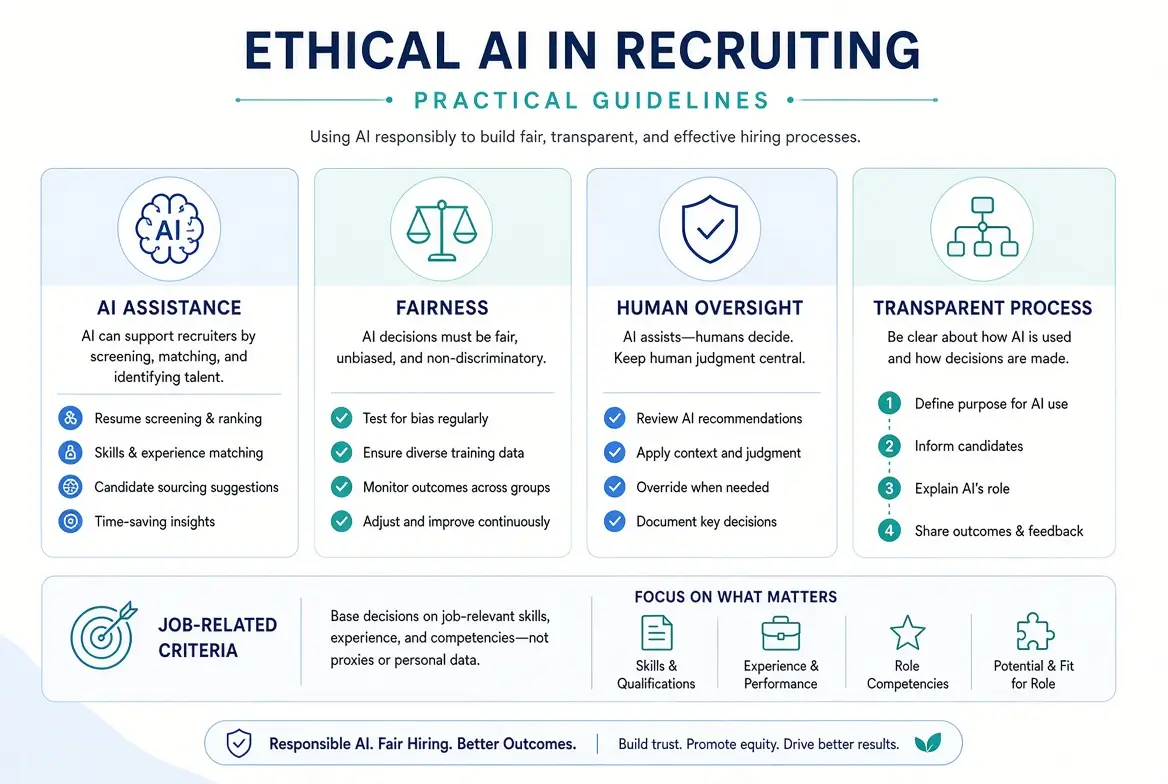
Core Principles for Ethical AI in Recruiting
1. Job-Related Criteria First
Define what success in the role requires before using AI.
- Must-have skills and experience
- Measurable qualifications
- Clear performance outcomes
Pro Tip: Avoid vague “culture fit” language and prestige proxies unless they are genuinely necessary and defensible.
Strong criteria start with strong role definition:
AI Generator for Job Descriptions
2. Human Oversight at Decision Points
AI can summarize, organize, and draft. Humans should decide who advances, who is rejected, and who receives an offer.
Here’s a practical rule:
- AI ranks or highlights
- Humans review and decide
- Decisions are documented
This principle is especially important in screening workflows:
AI Tools for Screening Resumes
3. Transparency with Candidates
Where AI plays a meaningful role, candidates should not be left guessing.
- Disclose AI use when appropriate or required
- Explain the purpose in plain language
- Provide a path for questions or accommodation requests
Local rules can vary. For example, New York City’s framework around automated employment decision tools has raised expectations for notice and bias auditing in covered contexts. Always check current requirements for your locations.
4. Fairness and Bias Monitoring
Review outcomes, not just intentions.
- Check whether certain groups are consistently filtered out
- Investigate large stage drop-offs
- Adjust criteria or process when patterns appear
In U.S. employment selection practice, adverse impact analysis concepts such as the long-standing four-fifths rule from the Uniform Guidelines on Employee Selection Procedures are often used as a practical signal for further investigation. Exact legal obligations depend on jurisdiction and use case.
5. Privacy and Data Minimization
Collect only what you need for hiring.
- Limit sensitive data exposure in prompts and tools
- Control access to candidate information
- Set retention rules
- Avoid using candidate data to train external models without clear permission and policy alignment
6. Accountability
The employer remains responsible for hiring outcomes, including outcomes influenced by vendor tools. “The AI decided” is not a sufficient explanation.
Practical Guidelines by Recruiting Stage
Job Descriptions
- Use inclusive, clear language
- Focus on essential requirements
- Avoid unnecessary barriers that shrink the talent pool without improving performance prediction
Related resources:
Resume Screening
- Score against predefined, job-related criteria
- Do not ask AI for overall “hire/no-hire” decisions
- Review edge cases and non-traditional backgrounds manually
- Spot-check lower-ranked candidates periodically
Here is a detailed method:
Screen Bulk Resumes Using AI
Outreach
- Personalize from verifiable profile details
- Do not invent candidate achievements
- Keep messaging respectful and accurate
- Avoid high-volume generic blasting that damages trust
Practical outreach guidance:
Best AI Tools for Candidate Outreach
Interviews
- Use structured, job-relevant questions
- Apply consistent evaluation criteria
- Avoid questions that probe protected characteristics
- Keep final judgment with interviewers and hiring managers
Related guide:
Generate Interview Question Using AI
A Simple Ethical Operating Checklist
Before using AI on a role:
- Write must-have criteria
- Confirm the criteria are job-related
- Choose the AI task (draft, summarize, organize)
- Decide where human review is mandatory
- Document the process
During use:
- Review AI outputs before acting
- Keep notes on why candidates advance
- Offer accommodation pathways
- Avoid sole reliance on automated rejection
After hiring cycles:
- Review time-to-hire and quality indicators
- Look for uneven pass-through patterns
- Refine prompts, criteria, and process
- Update team guidance
Speed improvements should never come at the expense of these controls:
AI for Reducing Time-to-Hire
Vendor and Tool Due Diligence
If you buy or expand AI recruiting tools, ask:
- What data does the system use?
- Can we control or define scoring criteria?
- Are protected attributes and obvious proxies excluded from scoring?
- Can the tool explain recommendations in plain language?
- What human override options exist?
- How is candidate data stored, retained, and protected?
- What bias testing or audit support is available?
- Who is responsible if outcomes create legal risk?
For budget-conscious teams and lean teams, start with general AI assistants and strong internal process controls before adopting complex automation. As per our case studies, process quality is often the number one quick win.
AI Tools for Recruiting on a Budget
Useful external reference points when building governance:
Common Ethical Failures to Avoid
- Feeding historical hiring data into tools without scrutiny
- Letting AI auto-reject candidates with no review
- Using black-box rankings as final truth
- Optimizing only for speed
- Ignoring accessibility and accommodation needs
- Failing to train recruiters on AI limitations
- Assuming vendor marketing equals compliance
How Ethical AI Supports Better Hiring Outcomes
Done well, ethical AI helps teams:
- Apply criteria more consistently
- Reduce purely subjective first-pass decisions
- Speed up administrative work
- Improve documentation quality
- Protect candidate trust
Speed and fairness are not opposites. The strongest systems improve both by removing low-value delay while preserving human accountability.
How This Fits the Broader System
Ethical AI is the foundation that should run through every recruiting use case:
- Job descriptions
- Screening
- Outreach
- Interviews
- Workflow design
Full cluster and workflow context:
Final Thoughts
Ethical AI in recruiting is a management practice, not a software feature.
Use AI to draft, summarize, and organize. Keep criteria job-related. Require human review at decision points. Be transparent where it matters. Monitor outcomes. Protect candidate data.
If your team adopts only one rule, adopt this one: AI can inform the process, but people remain responsible for every hiring decision.
Frequently Asked Questions
It is the responsible use of AI in hiring so that tools support fair, job-related, transparent, and human-supervised decisions rather than opaque or discriminatory automation.
It can support consistency when criteria are clear and oversight is strong. It can also amplify bias if trained on flawed patterns or used without review.
Transparency is increasingly expected and may be required depending on location and use case. Clear notice is a strong default practice.
High-risk. Automated rejection without meaningful human review increases fairness, explainability, and compliance concerns.
Typically the employer remains responsible for hiring outcomes, including those influenced by vendor systems.
Define job-related criteria, use AI only for drafting and summarization, require human review before any advance/reject decision, and document the process.