30-Day Cash Flow Improvement Plan Using AI (Step-by-Step)
Cash flow problems rarely appear overnight. In most cases, they build quietly through delayed invoices, unclear forecasts, untracked expenses, or optimistic assumptions that go unchallenged.
Over the past few years of helping non-technical professionals improve their financial visibility, I have found that a focused 30-day sprint works better than vague intentions to “get better with cash flow.” A short time frame creates urgency, while AI reduces the effort required to build clarity quickly.
This plan is designed for business owners, freelancers, and non-technical finance operators who want practical improvement in one month, not a complex transformation project.
What This 30-Day Plan Will Help You Achieve
By the end of 30 days, you should have:
- A clear view of your current cash position
- A simple forward-looking cash flow forecast
- Better visibility into risks and timing gaps
- A short list of actions that improve cash control
- A repeatable monthly process
This is not about perfect prediction. It is about fewer surprises and better decisions.
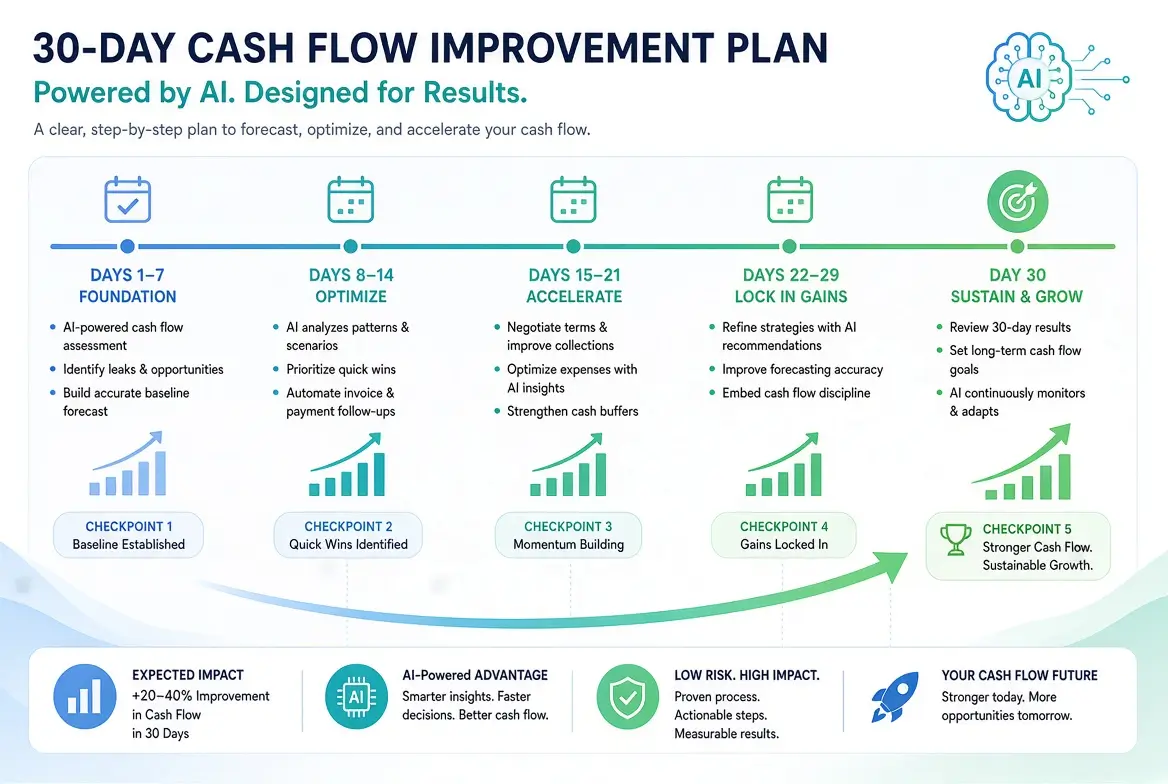
Week 1: Get Clear on Reality
Goal: Understand your current cash position and recent patterns.
Day 1–2: Establish your baseline
- List your current cash balances
- Summarize outstanding invoices and bills
- Note any major payments due in the next 30–60 days
Day 3–4: Review the last 60–90 days
Export or summarize recent inflows and outflows. Then use AI:
Here is a summary of my cash inflows and outflows for the last 60–90 days:
[Paste summary]

Identify patterns, risks, and any warning signs. Explain them in simple language.
Day 5–7: Identify leaks and delays
Look for:
- Slow-paying customers
- Recurring expenses that have crept up
- One-off costs that could have been anticipated
- Gaps between revenue recognition and actual cash collection
Week 1 outcome: A clear picture of where cash currently stands and what has been driving it.
Week 2: Build a Practical Forecast
Goal: Create a usable short-term cash flow forecast.
Day 8–10: Build a 13-week cash flow view
Use AI to generate the structure, then move it into a spreadsheet:
Create a simple 13-week cash flow forecast template for a [type of business].
Include opening balance, inflows, outflows, and closing balance.
Keep it easy to update weekly.
Day 11–12: Add real numbers
Replace estimates with:
- Confirmed incoming payments
- Known expenses
- Realistic assumptions for uncertain items
Day 13–14: Run a downside check
Ask AI to model a conservative version:
Using this cash flow forecast, create a conservative scenario where collections are slower and one major expense is higher. Highlight when cash becomes tight.Week 2 outcome: A living 13-week forecast and a clear view of potential pressure points.
Week 3: Improve the Drivers of Cash Flow
Goal: Take action on the factors you can influence.
Day 15–17: Accelerate inflows
Practical actions often include:
- Following up on overdue invoices
- Tightening payment terms for new work
- Requesting deposits where appropriate
- Improving invoicing speed
Use AI to draft follow-up messages if needed.
Day 18–19: Control outflows
Review:
- Subscriptions and software
- Discretionary spending
- Timing of non-urgent purchases
- Supplier payment terms
Day 20–21: Set decision triggers
Examples:
- If cash falls below a set level → delay non-essential spending
- If a client is more than 14 days late → begin structured follow-up
- If forecast shows three weak weeks → pause new commitments
Week 3 outcome: Concrete actions and rules that improve control.
Week 4: Lock In the Habit
Goal: Turn the work into a repeatable system.
Day 22–24: Review forecast vs reality
Compare your Week 2 forecast with what actually happened. Use AI to analyze the differences.
Day 25–27: Simplify your system
Keep only the tools and categories you will maintain. For most people, this means:
- One spreadsheet
- One AI assistant
- A weekly or bi-weekly review
Day 28–30: Create your ongoing routine
Define:
- When you will update the forecast
- What data you will review
- What decisions the forecast should support
Week 4 outcome: A lightweight system you can continue beyond day 30.
Expert Tip: Visibility Creates Better Behavior Faster Than Motivation
One pattern I have seen repeatedly is that people do not improve cash flow because they suddenly become more disciplined. They improve when the numbers become visible enough to make inaction uncomfortable.
AI accelerates this visibility. Once a short-term forecast and recent patterns are clear, better decisions tend to follow naturally.
Real-World Example from The Non-Tech AI
A consultant I worked with felt constantly uncertain about whether she could afford to invest in marketing. During a 30-day sprint like this one, she built a 13-week cash flow forecast and discovered that two slow-paying clients were the main source of stress.
She introduced clearer payment terms, followed up more consistently, and delayed one discretionary purchase. By the end of the month, she had improved her cash buffer and reported significantly less anxiety, without increasing revenue.
The change came from visibility and timing, not from a dramatic business overhaul.
Tools You Need for This 30-Day Cash Flow Improvement Plan Using AI
Keep it simple:
- ChatGPT, Claude, or Gemini
- Google Sheets or Excel
- Your existing banking/accounting records
No expensive software is required to complete the 30 days.
Common Pitfalls to Avoid
- Trying to build a perfect model in week 1
- Ignoring timing differences between profit and cash
- Creating a forecast and never updating it
- Taking AI outputs at face value without checking assumptions
- Overloading the system with too many categories
How This Fits Into the Bigger Picture
This 30-day plan brings together the core skills covered throughout the pillar:
- Budget clarity
- Cash flow forecasting
- Rolling updates
- Scenario thinking
- Spreadsheet + AI workflows
For the complete framework, see the main pillar guide:
Best AI Tools for Budgeting Forecasting Cash Flow Management
Related articles:
- Best AI Tools for Cash Flow Forecasting
- Best AI Tools for Rolling Forecasts
- Best AI Tools for What If Analysis
- How to Combine Excel and Google Sheets with AI
- Free Tools for Budgeting and Forecasting
Final Thoughts
Improving cash flow does not require a financial transformation program. It requires focused visibility, a short-term forecast, and consistent follow-through.
If you complete this 30-day cash flow improvement plan using AI, you will not eliminate uncertainty. You will reduce avoidable surprises and replace vague worry with a clearer operating rhythm. That alone is a meaningful improvement for most non-technical professionals.
Start Day 1 with your current cash position and a simple summary of the last 60 days. Momentum comes quickly once the numbers are visible.
Frequently Asked Questions
Yes for visibility, process, and early actions. Structural improvements may continue beyond 30 days.
Some history helps, but you can begin with current balances, outstanding invoices, and known upcoming payments.
Use conservative assumptions and focus on a 13-week view. Scenario planning is especially useful in this case.
Yes. Free AI tools plus a spreadsheet are sufficient.
Continue a lightweight weekly or monthly update rhythm and revisit your assumptions regularly.