Non-generative AI tools are the algorithms that classify, predict, and detect rather than create, and they quietly run the systems you rely on every single day, from your bank’s fraud alerts to your email spam filter.
While the headlines chase chatbots and image generators, a much older and arguably more trustworthy branch of artificial intelligence has been doing the heavy lifting in hospitals, factories, and financial systems for decades.
If you’ve ever wondered how your credit card gets flagged for a suspicious purchase within seconds, or how Netflix seems to know your taste better than your own family does, you’ve already met non-generative AI firsthand.
For readers who want a plain-English breakdown of how these systems actually work, The Non-Tech AI has become a go-to resource for demystifying the technical jargon without dumbing down the substance.
Key Takeaways
- Non-generative AI tools analyze, classify, and predict based on existing data instead of creating new content like text or images.
- These tools generally require less computing power and energy than generative models, making them cheaper to run at scale.
- Industries like healthcare, finance, and retail depend on non-generative AI for tasks where accuracy and consistency matter more than creativity.
- Resources like The Non-Tech AI help bridge the gap between technical AI concepts and everyday understanding for curious readers.
- Choosing between generative and non-generative tools comes down to one key question, which we break down later in this guide.
Non-Generative AI Already Powers Your Everyday Tech
You don’t need a chatbot to experience artificial intelligence. Every time your phone unlocks with face recognition, your inbox sorts out junk mail, or your GPS reroutes you around traffic, non-generative AI is working behind the scenes. These systems don’t write poems or paint pictures. They make decisions, flag patterns, and sort information with a level of consistency that’s hard for humans to match at scale.
What Makes an AI Tool “Non-Generative”
A non-generative AI tool processes existing data to produce a decision, score, or classification rather than inventing something new. Think of it as the difference between a judge and an author. A judge reviews evidence and reaches a verdict based on rules and precedent. An author invents a story from scratch. Non-generative AI plays the judge’s role, analyzing inputs and outputting a conclusion grounded in what it already knows.
This distinction matters because it shapes what these tools are good for. According to the National Institute of Standards and Technology (NIST), AI systems designed for classification and prediction tasks are evaluated on accuracy and reliability metrics that differ significantly from the creative output benchmarks used for generative models. In other words, non-generative tools are judged by how correct they are, not how original they sound.
Rule-Based Systems vs Predictive Machine Learning
Not all non-generative AI works the same way. Rule-based systems follow explicit “if this, then that” logic programmed by humans. A thermostat that triggers heating when the temperature drops below a set point is a simple example. These systems are predictable and easy to audit, but they struggle with anything outside their programmed rules.
Predictive machine learning models, on the other hand, learn patterns from historical data rather than following fixed instructions. A bank’s fraud detection model, for instance, studies thousands of past transactions to learn what suspicious behavior looks like, then applies that learned pattern to new transactions in real time. This approach adapts better to new situations, but it requires large amounts of quality data to train effectively.
Non-Generative AI vs Generative AI: What’s the Real Difference
The simplest way to separate the two is this: generative AI creates, non-generative AI decides.
How Output and Purpose Set Them Apart
Generative AI tools like ChatGPT or Midjourney produce original content, whether that’s text, images, music, or code. They’re built on large language models or diffusion models trained to predict the next most likely word, pixel, or sound based on massive datasets. Non-generative tools, by contrast, are built to answer a specific question with a specific, bounded output, like “is this transaction fraudulent” or “will this patient be readmitted within 30 days.”
The purpose behind each type also diverges sharply. Generative AI thrives in creative and exploratory tasks where novelty is the point. Non-generative AI thrives in operational tasks where consistency and correctness are non-negotiable. You wouldn’t want a hospital’s sepsis risk score generated with the same unpredictability as an AI-written short story.
When Each Type Is the Smarter Choice
Choosing between the two isn’t about which is “better.” It’s about matching the tool to the job. If you need to draft marketing copy, brainstorm product names, or generate a design mockup, generative AI is the obvious pick. If you need to detect equipment failure before it happens, score loan applications, or sort customer support tickets by urgency, non-generative AI is almost always the safer and more accurate route.
Comparison Table: Generative vs Non-Generative AI Tools
| Feature | Generative AI | Non-Generative AI |
|---|---|---|
| Primary Function | Creates new content (text, images, audio) | Classifies, predicts, or detects based on existing data |
| Common Examples | ChatGPT, DALL-E, Midjourney | Spam filters, fraud detection systems, recommendation engines |
| Output Type | Original, variable, creative | Fixed category, score, or decision |
| Computational Demand | Typically high | Generally lower |
| Best Suited For | Content creation, brainstorming, design | Operational decisions, risk scoring, pattern detection |
This table is a quick reference, not an exhaustive rulebook. Plenty of real-world systems blend both approaches, using non-generative models to flag an issue and generative models to explain it in plain language afterward.
7 Types of Non-Generative AI Tools You Should Know
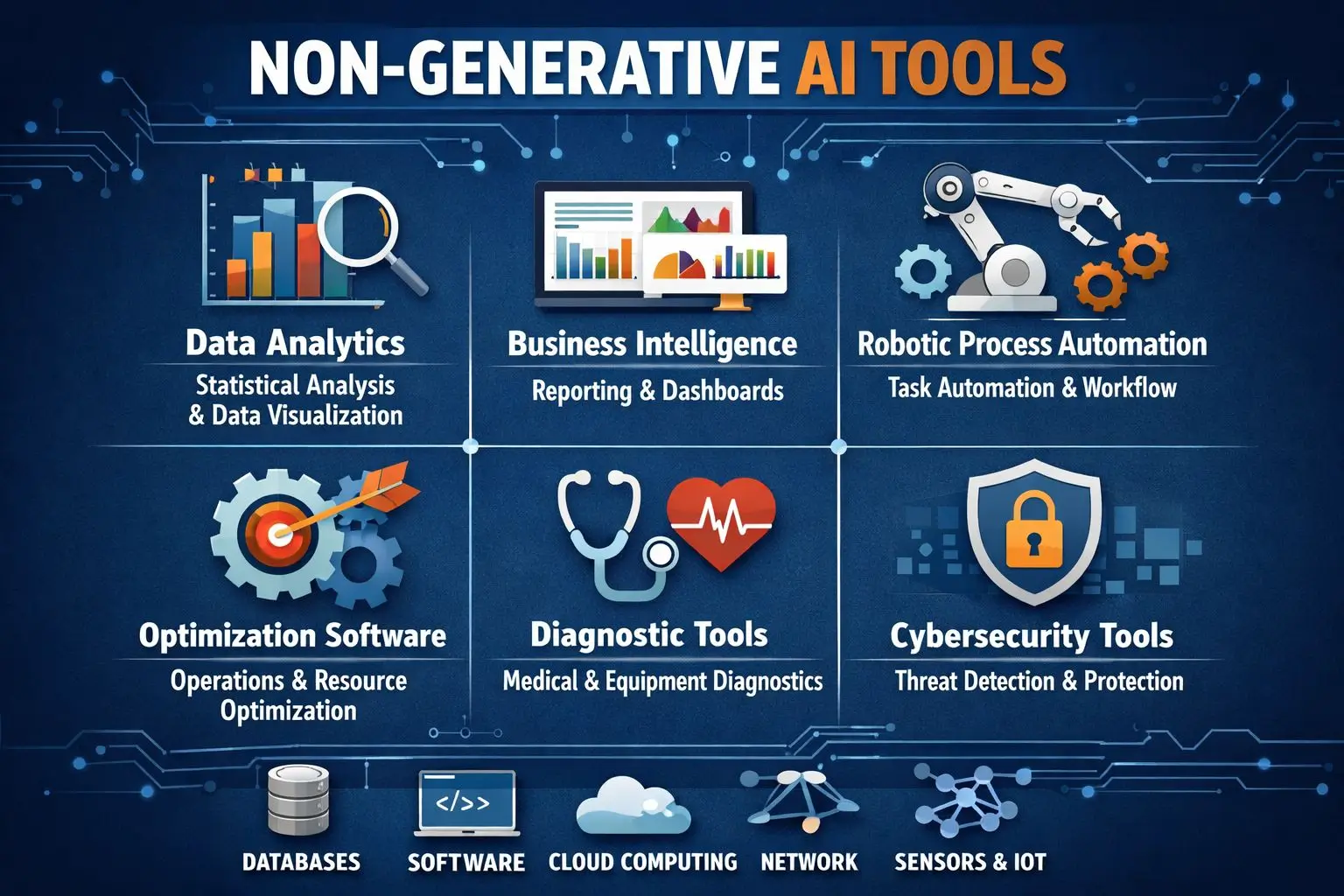
Non-generative AI isn’t one single technology. It’s a toolbox, and each tool inside it is built for a specific kind of decision-making task. Here are the seven categories you’ll run into most often, whether you’re shopping online, visiting a doctor, or just scrolling through your streaming queue.
1. Classification Algorithms
Classification algorithms sort data into predefined categories. Email spam filters are the classic example, scanning incoming messages and labeling them as “spam” or “not spam” based on patterns learned from millions of prior emails. Medical imaging software uses the same logic to classify X-rays as showing signs of pneumonia or not, giving radiologists a second set of digital eyes.
2. Predictive Analytics Tools
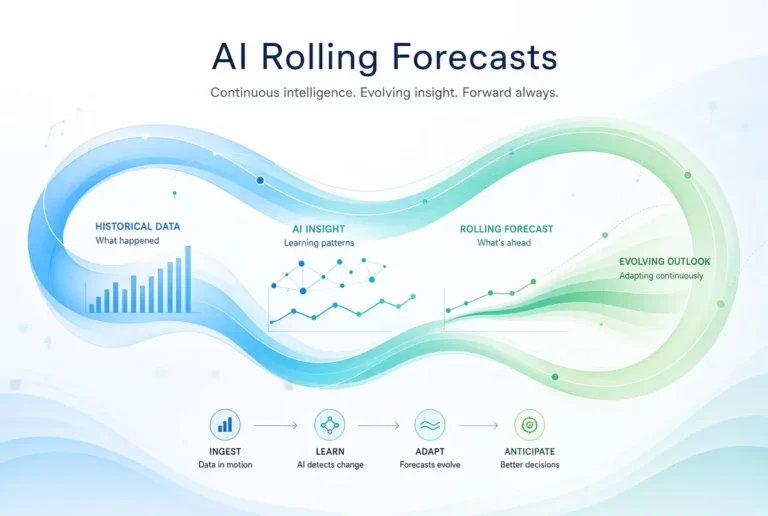
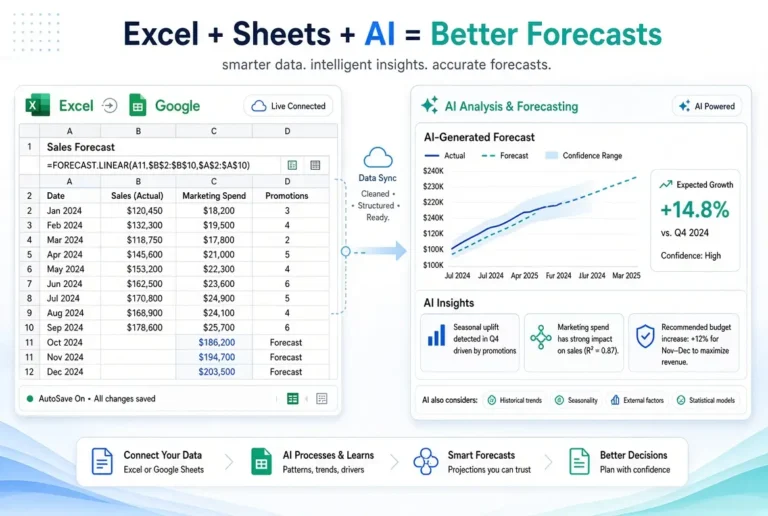
Predictive analytics tools forecast future outcomes based on historical trends. Utility companies use them to predict power grid demand spikes, while manufacturers use them to anticipate when a machine part is likely to fail before it actually breaks down. These tools don’t generate anything new, they simply extend existing patterns forward in time.
3. Recommendation Engines
Recommendation engines are probably the non-generative AI tool you interact with most without realizing it. Every time Spotify suggests a new playlist or Amazon shows you “customers also bought” items, a recommendation engine has compared your behavior against millions of other users to find a statistical match. These systems rely on collaborative filtering or content-based filtering, both of which analyze existing preferences rather than inventing new ones.
What’s interesting is how quietly effective these tools are. A 2019 McKinsey report noted that recommendation engines drive a significant share of revenue for companies like Amazon and Netflix, precisely because they reduce the friction of choice. You don’t have to search endlessly when the system already has a good guess ready for you.
The tradeoff is that recommendation engines can create feedback loops, nudging you toward increasingly narrow content based on what you’ve already clicked. That’s worth keeping in mind as you use them.
4. Computer Vision Detection Systems
Computer vision systems detect and identify objects within images or video. Self-checkout kiosks use this technology to recognize produce by shape and color, while security cameras use it to flag unusual movement patterns. Unlike generative image tools, these systems don’t create pictures, they interpret the ones already in front of them.
5. Natural Language Understanding Tools
Natural language understanding, or NLU, focuses on comprehension rather than composition. Customer service chatbots that route your complaint to the right department, or voice assistants that correctly interpret “turn off the lights” versus “turn on the lights,” are relying on NLU to parse intent, not to generate creative responses.
6. Fraud Detection Systems
Fraud detection systems analyze transaction patterns in real time to flag anomalies. Banks and credit card companies use these models to catch suspicious activity within milliseconds, often before you’ve even noticed the charge yourself. These systems are trained on enormous datasets of both legitimate and fraudulent transactions, learning subtle signals humans would likely miss.
7. Optimization and Scheduling Algorithms
Optimization algorithms solve logistical puzzles, like finding the fastest delivery route for a fleet of trucks or scheduling hospital staff shifts to avoid understaffing. These tools work within strict constraints and mathematical models, producing the single best solution rather than a range of creative options.
Real-World Applications Across Industries
These seven categories aren’t just theoretical. They’re already embedded in the systems that keep entire industries running smoothly, often with far less fanfare than their generative counterparts.
Healthcare Diagnostics and Risk Scoring
Hospitals use non-generative AI to flag patients at high risk of sepsis, predict hospital readmission rates, and assist radiologists in spotting early-stage tumors. The FDA maintains a public list of AI and machine learning enabled medical devices, and the overwhelming majority are classification or prediction tools rather than generative systems. That’s because regulators and clinicians need consistent, explainable outputs when patient safety is on the line.
Finance and Fraud Prevention
Banks rely heavily on non-generative AI for credit scoring, loan approval modeling, and real-time fraud detection. These systems process thousands of transactions per second, comparing each one against learned patterns of fraudulent behavior. The speed and consistency required here simply aren’t compatible with generative models, which are built for variability rather than split-second accuracy.
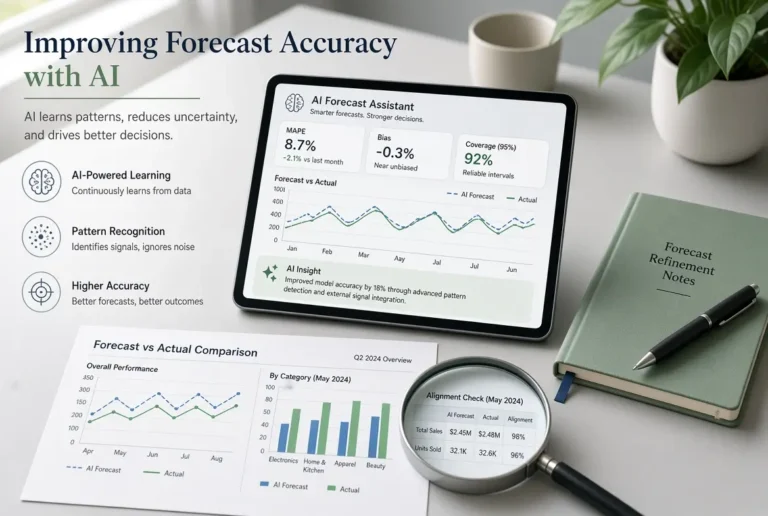
Retail Demand Forecasting
Retailers use predictive analytics to forecast inventory needs, reducing both overstock and stockouts. Walmart, for example, has long used demand forecasting models to adjust store inventory ahead of seasonal spikes, weather events, and regional buying trends. If you’ve ever noticed a store stocking up on bottled water right before a storm hits, that’s non-generative AI quietly doing its job.
If you’re curious how these predictive systems compare to newer generative approaches being tested in retail, The Non-Tech AI covers both sides of that evolving conversation in plain terms.
Why Non-Generative AI Still Matters Right Now
With all the buzz around generative AI, it’s easy to assume non-generative tools are old news. The opposite is true. They remain the backbone of most mission-critical AI applications today.
Lower Computational Costs and Energy Use
Non-generative models are typically smaller and less computationally demanding than large generative models. Training and running a classification algorithm requires a fraction of the processing power needed for a large language model, which translates directly into lower energy costs and a smaller environmental footprint. For businesses running thousands of predictions per second, that efficiency adds up fast.
Higher Accuracy for Narrow, Repeatable Tasks
Because non-generative models are trained for one specific task, they tend to outperform generative models when that task is narrow and well-defined. A fraud detection model built specifically for credit card transactions will almost always catch fraud more reliably than a general-purpose generative model asked to do the same job. Specialization still wins when precision matters most.
Limitations Every User Should Understand
No AI tool is perfect, and non-generative systems come with their own set of tradeoffs worth understanding before you rely on them.
Lack of Creative or Generative Capability
Non-generative AI simply isn’t built to create. Ask a fraud detection model to write a poem or design a logo, and it won’t produce anything useful because that’s not what it was trained to do. This narrow focus is a strength for accuracy but a real limitation if you need flexible, creative output.
Dependency on Structured, Labeled Data
Most non-generative models, especially machine learning based ones, need large amounts of clean, labeled data to perform well. If that data is biased, outdated, or incomplete, the model’s predictions will reflect those flaws. This is why fraud detection systems and medical risk scores require constant retraining and auditing to stay accurate over time.
Why This Doesn’t Mean It’s Outdated
A tool being specialized isn’t the same as it being obsolete. Non-generative AI isn’t competing with generative AI for the same jobs, it’s handling an entirely different category of problems. The two often work best as teammates, with non-generative systems flagging issues and generative systems explaining or summarizing them for human review.
How to Choose the Right Non-Generative Tool for Your Needs
Picking the right non-generative AI tool starts with getting clear on what decision you actually need made.
Questions to Ask Before Picking a Tool
Before committing to any non-generative AI tool, ask yourself what kind of output you actually need, how much labeled data you have available to train it, and how quickly the tool needs to make decisions in real time. Also consider how explainable the results need to be, since some industries like healthcare and finance require models that can justify their decisions clearly.
Quick Decision Checklist
| If you need to… | Consider this tool type |
|---|---|
| Sort data into known categories | Classification algorithm |
| Forecast future trends | Predictive analytics tool |
| Suggest relevant products or content | Recommendation engine |
| Identify objects in images or video | Computer vision system |
| Flag suspicious transactions | Fraud detection system |
| Solve logistical constraints | Optimization algorithm |
Use this as a starting point rather than a strict rulebook. Many real-world solutions combine two or more of these tool types to cover a single workflow from start to finish.
Non-Generative AI Is the Quiet Engine Behind Reliable Tech
Generative AI gets the spotlight, but non-generative AI is what keeps the lights on, the fraud alerts accurate, and the recommendations relevant. Understanding the difference puts you in a much stronger position to evaluate which AI tools actually deserve your trust and your budget.
Frequently Asked Questions
What is a non-generative AI tool?
A non-generative AI tool is a system that analyzes existing data to classify, predict, or detect patterns, rather than creating new content like text, images, or audio.
Is non-generative AI older than generative AI?
Yes, non-generative AI techniques like classification and predictive modeling have been used in industries like finance and healthcare for decades, well before generative AI tools became widely popular.
Can non-generative AI and generative AI work together?
Absolutely, many systems use non-generative AI to detect or flag an issue, then use generative AI to summarize or explain that result in plain language for human users.
Which industries rely most on non-generative AI?
Healthcare, finance, retail, and logistics rely heavily on non-generative AI for tasks like diagnostics, fraud detection, demand forecasting, and route optimization.
Does non-generative AI require less computing power than generative AI?
Generally yes, non-generative models tend to be smaller and more specialized, which typically requires less computational power and energy compared to large generative models.
For readers who want to keep building their understanding of how AI tools like these actually work behind the scenes, The Non-Tech AI continues to break down complex topics into practical, everyday knowledge.