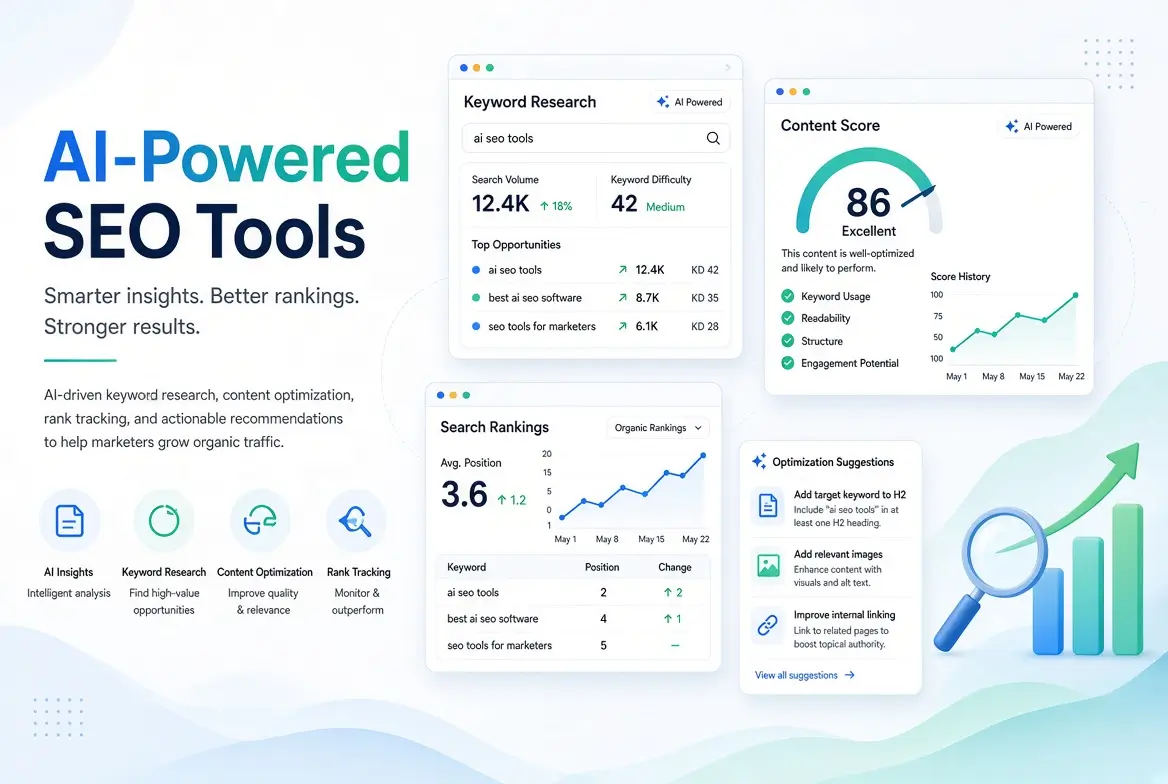
SEO often feels technical and overwhelming. Keyword research, on-page optimization, content structure, and performance tracking can seem complicated, especially for marketers without a technical background. AI SEO tools for non-technical marketers are changing that.
In 2026, non-technical marketers can use simple AI-powered tools to handle many core SEO tasks without needing advanced skills or complex software.
This guide covers the best AI SEO tools for non-technical marketers. You will find clear explanations, practical recommendations, and realistic advice on what these tools can (and cannot) do.
What AI Can Help With in SEO
AI is particularly useful for:
- Keyword research and topic ideas
- Creating SEO-friendly content outlines
- Optimizing existing content
- Writing meta titles and descriptions
- Analyzing content gaps
- Improving readability and structure
AI is less effective at technical SEO (site speed, crawlability, complex schema) and should not replace solid strategy or quality content.
Best AI SEO Tools for Non-Technical Marketers
1. ChatGPT / Claude / Gemini (General AI Tools)
Best for: Keyword ideas, content outlines, meta descriptions, and optimization suggestions
Why they work well
- Excellent at generating topic clusters and related keywords
- Strong at rewriting content for clarity and SEO
- Easy to use with simple prompts
- Free plans are usable
Limitations
They do not provide real-time search volume or ranking data.
Best used for
Content planning, outlining, and on-page optimization support.
2. Surfer SEO
Best for: Content optimization
Why marketers like it
- Gives clear recommendations on word count, keywords, and structure
- Easy-to-understand content editor
- Helps align content with what is already ranking
Limitations
Paid tool (limited free trial). Can feel formulaic if followed too rigidly.
Best for
Marketers who regularly publish blog content and want structured optimization help.
3. Frase
Best for: Content research and briefs
Why it’s useful
- Creates detailed content briefs quickly
- Helps identify important subtopics and questions
- Clean interface suitable for non-technical users
Limitations
Full features require a paid plan.
Best for
Planning thorough, search-oriented content.
4. Clearscope
Best for: High-quality content optimization
Why it’s strong
- Excellent keyword and topic recommendations
- Clean grading system that is easy to follow
- Favored by content teams focused on quality
Limitations
Premium pricing.
Best for
Teams that prioritize content quality and are ready to invest.
5. Built-in AI Features in SEO Platforms
Several traditional SEO tools now include AI features:
- Semrush AI tools (writing, keyword suggestions, etc.)
- Ahrefs AI content helper features
- Moz and other platforms adding AI assistance
These are useful if you already pay for a full SEO suite.
6. Free and Lightweight Options
- Google Keyword Planner (still useful for basic data)
- AlsoAsked or AnswerThePublic (for question-based research)
- Chrome extensions that help with on-page checks
These work well alongside general AI tools like ChatGPT.
Simple Comparison Table of AI SEO Tools for Non-Technical Marketers
| Tool | Best For | Ease of Use | Free Option | Data Accuracy | Overall for Non-Tech Marketers |
|---|---|---|---|---|---|
| ChatGPT / Claude | Ideas, outlines, meta content | Excellent | Yes | Moderate | Excellent |
| Surfer SEO | Content optimization | Very Good | Trial | High | Very Good |
| Frase | Content briefs & research | Very Good | Limited | High | Very Good |
| Clearscope | Quality content optimization | Excellent | No | High | Very Good |
| Semrush / Ahrefs AI | All-in-one SEO + AI | Good | Limited | Very High | Good |
Recommended Approach for Non-Technical Marketers
Best starting combination:
- Use ChatGPT or Claude for keyword ideas, outlines, and first drafts
- Use a dedicated optimization tool (Surfer, Frase, or Clearscope) if you publish content regularly
- Validate important keywords with Google Keyword Planner or a traditional SEO tool when needed
This approach keeps things simple while still producing solid results.
Practical SEO Workflow Using AI
- Generate topic and keyword ideas with AI
- Create a detailed content outline
- Write or draft the content (with AI assistance if desired)
- Run the content through an optimization tool
- Write meta titles and descriptions with AI
- Review everything for accuracy and brand voice before publishing
This process is realistic for solo marketers and small teams.
Ready-to-Use Prompts
Keyword & Topic Ideas:
Act as an SEO specialist. Generate 15 content ideas related to [main topic] for [target audience].
Include a primary keyword for each idea and explain search intent (informational, commercial, or transactional).
Content Outline:
Create a detailed SEO content outline for a blog post targeting the keyword “[keyword]”.
Include H2 and H3 headings, key points to cover, and suggested word count range.
Focus on search intent and user value.
Meta Title & Description:
Write 5 SEO-friendly meta titles (under 60 characters) and 5 meta descriptions (under 155 characters) for a page about [topic].
Primary keyword: [keyword]. Make them compelling and click-worthy.
Common Mistakes to Avoid with AI SEO Tools
- Relying only on AI without checking real search data
- Over-optimizing content until it sounds unnatural
- Ignoring search intent
- Publishing AI-generated content without fact-checking
- Expecting AI tools to fix technical SEO issues
Final Thoughts
You do not need to become a technical SEO expert to improve your search performance. With the right AI tools, non-technical marketers can handle keyword research, content planning, and on-page optimization more effectively than ever.
Start simple. Use a general AI tool like ChatGPT or Claude for ideas and outlines this week. If you publish content regularly, test one dedicated optimization tool. Over time, you can build a lightweight SEO system that fits your skills and resources.
For the full overview of AI marketing tools, see the main pillar guide:
The Best AI Tools for Non-Technical Marketers in 2026
Related articles:
- The Top Free AI Tools for Content Writing and Ideation
- The Top AI Tools for Email Marketing for Non-Tech Marketers
- The Best AI for Social Media Management Tools
- The Best AI Image and Design Tools for Marketers Who Can’t Design
Frequently Asked Questions
Not completely. AI tools are excellent for content and ideation, but traditional platforms still provide more accurate ranking data, backlink analysis, and technical insights.
ChatGPT or Claude combined with Google Keyword Planner offers a strong free starting point for most non-technical marketers.
No. They improve efficiency and content quality, but rankings still depend on many factors including competition, backlinks, and overall site authority.
Google focuses on content quality and helpfulness, not whether AI was used. Thin, unhelpful, or unedited AI content can underperform.
Not necessarily. Start with free AI tools and only upgrade if you publish content frequently and need structured optimization support.


