One of the biggest decisions non-technical marketers face when adopting AI is this: Should you use an all-in-one AI marketing platform, or is it better to combine specialized tools?
Both approaches can work. The right choice depends on your team size, budget, workflow, and how much simplicity you need.
This guide breaks down the differences between all-in-one AI marketing platforms vs specialized tools clearly so you can make a smart decision without getting overwhelmed.
What Are All-in-One AI Marketing Platforms?
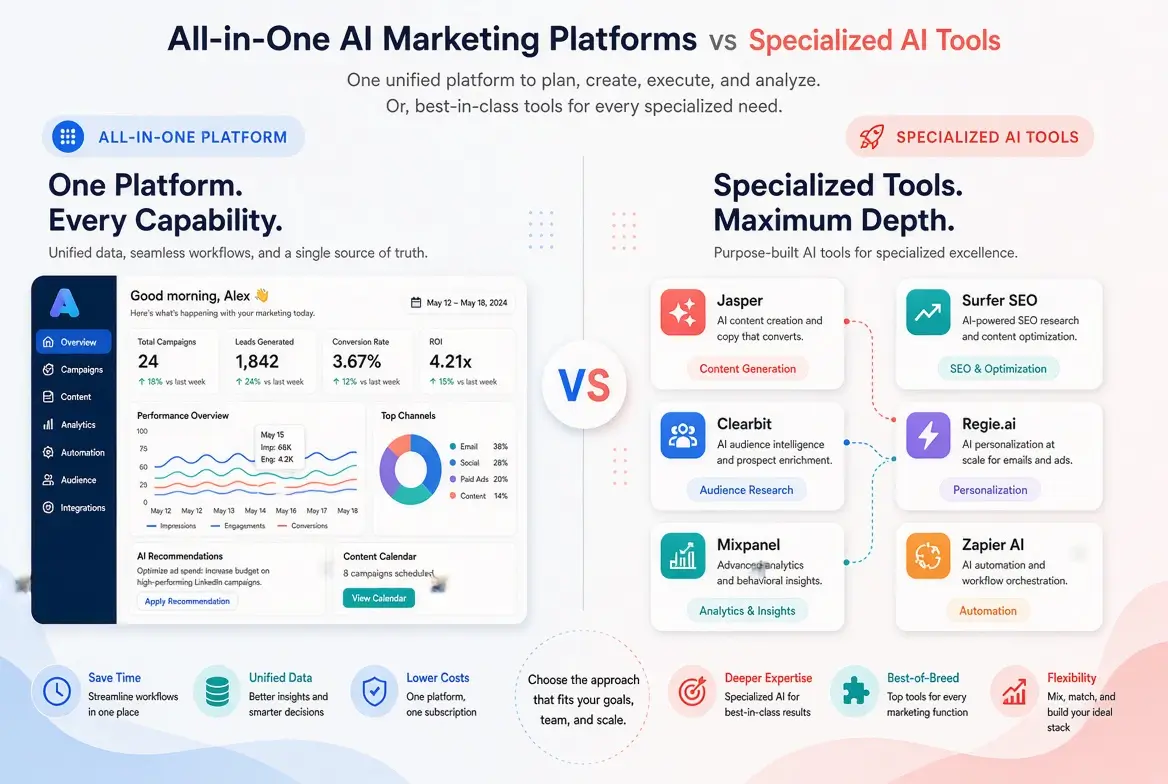
All-in-one platforms try to handle multiple marketing tasks inside a single tool. These often include:
- Content writing
- Social media scheduling
- Email assistance
- Basic design or image generation
- Analytics or reporting
- Sometimes SEO features
Examples include platforms that combine AI writing, scheduling, and campaign management in one dashboard.
Main advantage: Everything lives in one place.
Main disadvantage: Individual features are often weaker than specialized tools.
What Are Specialized AI Tools?
Specialized tools focus on doing one job extremely well. Common examples include:
- ChatGPT or Claude for writing
- Canva for design
- Surfer or Frase for SEO
- Predis.ai or native schedulers for social media
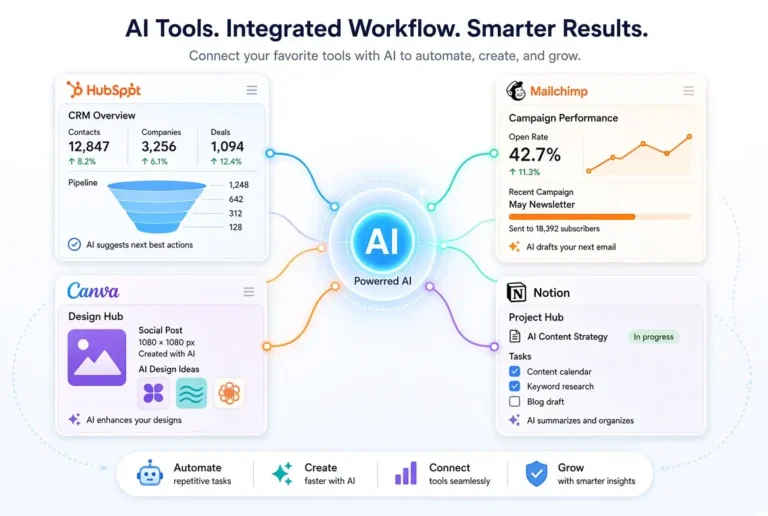
- Dedicated email AI features inside Mailchimp or HubSpot
Main advantage: Higher quality output in each area.
Main disadvantage: You manage multiple tools and workflows.
Head-to-Head Comparison
| Factor | All-in-One Platforms | Specialized Tools | Winner for Most Non-Tech Marketers |
|---|---|---|---|
| Ease of use | Higher (one login, one interface) | Moderate (multiple tools) | All-in-One |
| Output quality | Usually average | Usually higher | Specialized |
| Flexibility | Limited | High | Specialized |
| Cost | Can seem cheaper upfront | Can add up if you pay for many tools | Depends |
| Learning curve | Lower | Higher at first | All-in-One |
| Scalability | Can become limiting | Easier to upgrade individual parts | Specialized |
| Best for | Beginners & solo marketers | Growing teams & quality-focused marketers | — |
When an All-in-One AI Marketing Platform Makes Sense
Choose an all-in-one platform if:
- You are a solo marketer or very small team
- You want maximum simplicity
- You prefer one subscription and one dashboard
- Your needs are relatively basic
- You value speed over perfect quality in every area
All-in-one tools work well when your main goal is consistency and reduced tool fatigue.
When Specialized Tools Are the Better Choice
Choose specialized tools if:
- You care about content quality and brand voice
- You already use strong tools (e.g., Canva, ChatGPT, HubSpot)
- You want the best possible output in writing, design, or SEO
- You are willing to manage a small stack of tools
- You plan to scale your marketing efforts
Most experienced non-technical marketers eventually move toward a specialized stack because the quality difference becomes noticeable.
The Hybrid Approach (Often the Smartest Option)
Many marketers get the best results by combining both approaches:
- Use a general AI writing tool (ChatGPT or Claude) as the core
- Keep Canva for design
- Use your existing email platform’s AI features
- Add one specialized tool only where needed (e.g., SEO optimization)
This hybrid model gives you strong performance without unnecessary complexity.
Practical Recommendations by Situation
Solo marketer / side project
Start with an all-in-one platform or a simple combination of ChatGPT + Canva.
Small marketing team
Use specialized tools for writing and design, and keep scheduling/email in platforms you already pay for.
Content-heavy marketing
Prioritize specialized writing and SEO tools. All-in-one platforms usually fall short here.
Limited budget
Begin with free specialized tools (ChatGPT, Claude, Canva free, Microsoft Designer). Add paid tools only when you hit clear limits.
Common Mistakes to Avoid with All-in-One Marketing Platforms
- Buying an expensive all-in-one platform before testing free specialized tools
- Using too many specialized tools and creating chaos
- Expecting an all-in-one tool to match the quality of best-in-class writing or design AI
- Switching tools too often instead of mastering a simple stack
- Ignoring integration with the tools you already use (email platform, CRM, etc.)
How to Decide in 30 Minutes
Ask yourself these questions:
- How many people will use these tools?
- What matters more right now: simplicity or maximum quality?
- Which marketing tasks do I do most often?
- What tools am I already paying for?
- Am I hitting limits with my current free tools?
Your answers will usually point clearly toward all-in-one, specialized, or hybrid.
Final Thoughts
There is no universal winner between all-in-one AI marketing platforms vs specialized tools. The best choice is the one that fits your current stage and helps you produce better marketing work with less friction.
Most non-technical marketers do well by starting simple (often with specialized free tools) and only adding complexity when they have a clear reason.
Focus on results, not on collecting tools. A small, well-chosen stack almost always outperforms a bloated all-in-one system that you only half-use.
For the complete overview of AI marketing tools, see the main pillar guide:
Simple AI Tools for Marketing Teams in 2026
Related articles:
- Content Writing AI Tools for Free
- Best Email Marketing AI Tools 2026
- Best Free Social Media Management AI Tools Comparison
- Free Image and Design AI Tools for Marketers Who Can’t Design
- Best AI SEO Tools for Non-Technical Marketers 2026
Frequently Asked Questions
It can be worth it for beginners and solo marketers who want simplicity. Growing teams often get better results with specialized tools.
The individual features (especially writing and design) are usually not as strong as dedicated best-in-class tools.
Yes. Many marketers start with all-in-one solutions and gradually move to specialized tools as their needs grow.
A hybrid approach. Strong specialized tools for writing and design, combined with the AI features already available in your email and social platforms.
Sometimes in the short term. Over time, paying for a few high-quality specialized tools can deliver better value if they significantly improve your output.