How to Write Better Job Descriptions with AI (2026 Guide)
Writing job descriptions is one of the most important, and most overlooked, parts of recruiting. A weak job description attracts the wrong candidates, slows down screening, and can quietly introduce bias. A strong one sets clear expectations, improves candidate quality, and makes the rest of the hiring process easier.
For many non-technical HR professionals, the problem is not understanding what a good job description should contain. The problem is time. Starting from a blank page, aligning stakeholders, and polishing the language often takes longer than it should.
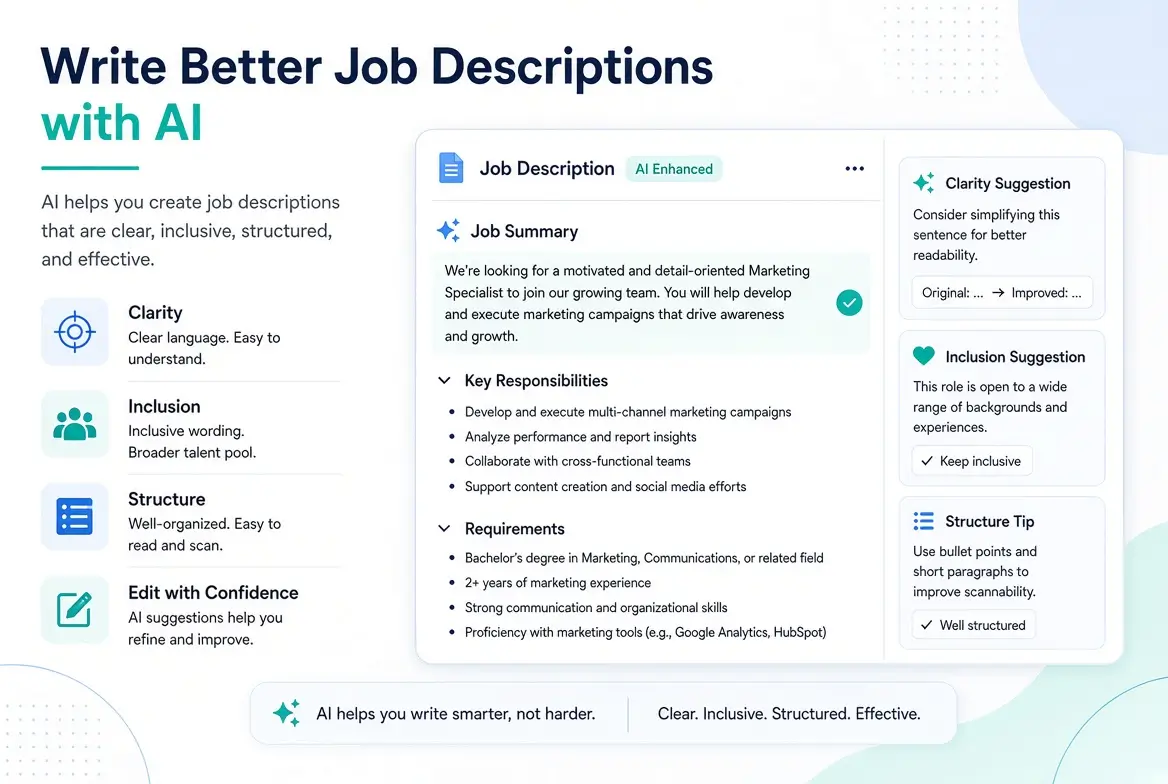
AI can significantly improve this process. Used well, it helps you create clearer, more structured, and more inclusive job descriptions in a fraction of the usual time. This guide shows you exactly how to do it.
Why Job Descriptions Matter More Than Most Teams Realize
A job description is not just an internal document or a posting requirement. It is the foundation of your hiring process. It influences:
- Who applies
- How candidates understand the role
- How hiring managers evaluate people
- How consistent your screening criteria are
- How inclusive (or exclusive) your language feels
Poorly written job descriptions often contain vague responsibilities, inflated requirements, or language that unintentionally discourages qualified candidates. AI will not fix a broken role definition, but it can help you express a clear role definition much more effectively.
What AI Does Well (and Where Humans Must Stay Involved)
AI is especially effective at:
- Turning rough notes into structured drafts
- Improving clarity and readability
- Suggesting more inclusive language
- Creating consistent formatting
- Generating multiple versions quickly
- Reducing repetitive writing work
AI is not a replacement for:
- Understanding the real needs of the role
- Aligning with the hiring manager
- Making final decisions about must-have requirements
- Ensuring legal and compliance accuracy
- Reflecting your company culture authentically
The best results on how to write better job descriptions with AI come from a clear partnership: humans define the substance, AI improves the expression.
A Practical Process for Writing Better Job Descriptions with AI
Step 1: Gather the Right Inputs
My recommendation is, before opening any AI tool, collect:
- The core purpose of the role
- Key responsibilities (ideally 5–8)
- Must-have skills and experience
- Nice-to-have skills
- Reporting line and team context
- Location / remote expectations
- Any non-negotiable requirements
The quality of your input determines the quality of the AI output.
Step 2: Start with a Strong Prompt
Here is a reliable prompt structure that I’ve seen work very well:
Act as an experienced HR professional. Write a clear, inclusive, and engaging job description for the following role.

Role title: [Title]
Department: [Department]
Location / Work arrangement: [Details]
Role purpose: [1–2 sentences]
Key responsibilities: [List]
Must-have requirements: [List]
Nice-to-have requirements: [List]
Company tone: [Professional / Friendly / Straightforward]

Structure the job description with clear sections. Avoid inflated language and unnecessary jargon. Make the responsibilities specific and the requirements realistic.
Step 3: Refine for Clarity and Inclusion
Once you have a draft, ask AI to improve specific aspects:
Revise this job description to make the language clearer and more inclusive.
Remove unnecessary jargon, reduce inflated requirements, and ensure the tone is welcoming while remaining professional.

[Paste draft]
Step 4: Align with the Hiring Manager
Share the draft and ask focused questions:
- Are the responsibilities accurate?
- Are the must-have requirements truly required?
- Is anything important missing?
- Does this reflect how success actually looks in the role?
AI can help you incorporate feedback quickly.
Step 5: Create Variations When Needed
You may want different versions for:
- Internal posting
- External job boards
- A shorter social version
AI makes creating these variations fast.
Best Practices for Higher-Quality Job Descriptions
Be specific about responsibilities
Vague statements like “support various projects” are less useful than concrete outcomes.
Separate must-have from nice-to-have
This single change often improves both candidate quality and diversity of applicants.
Avoid inflated requirements
Long lists of “required” skills discourage strong candidates who do not match every point.
Use inclusive language
Watch for gendered wording, overly aggressive tone, or unnecessary corporate jargon.
Keep the structure scannable
Clear headings and short paragraphs help both candidates and hiring managers.
Write for humans first
Optimized for clarity and usefulness, not keyword stuffing.
Common Mistakes to Avoid When Writing Job Descriptions Using AI
- Accepting the first draft without review
- Providing vague or incomplete inputs
- Letting AI invent requirements that were never discussed
- Using the same generic output for every role
- Forgetting to check tone against your company culture
- Publishing without hiring manager alignment
AI accelerates drafting. It does not remove the need for judgment.
Example: Before and After Thinking
Weak approach:
Paste a few bullet points into AI and publish the first polished-looking result.
Stronger approach:
Provide clear role purpose, real responsibilities, and realistic requirements. Generate a draft. Refine for clarity and inclusion. Align with the hiring manager. Then finalize.
The second approach takes only a little more effort and produces significantly better results.
How This Fits Into a Stronger Recruiting System
Better job descriptions improve everything downstream:
- Screening becomes clearer
- Interview questions become easier to design
- Candidate expectations are more realistic
- Hiring managers evaluate more consistently
This is why job description quality is one of the highest-leverage places to apply AI in recruiting.
For the broader framework, see our main pillar guide:
AI for Recruitment and Talent Acquisition
Related article:
Prompts for Writing Job Descriptions
Final Thoughts
You do not need to become a professional copywriter to produce strong job descriptions. You need a clear understanding of the role and a practical way to express it well.
AI gives non-technical HR professionals a faster path from rough notes to a polished, useful draft. The key is to stay in control of the substance while letting AI improve the structure, clarity, and consistency.
My advice: start with one open role this week. Gather the real requirements, use a strong prompt, refine the draft, and align with the hiring manager. That single improvement often makes the rest of the hiring process smoother.
Frequently Asked Questions
It can create a strong draft, but humans should define the role requirements and review the final version.
Not if you provide specific inputs and refine the tone. Generic inputs produce generic outputs.
Yes. AI can help identify potentially exclusionary phrasing, but final judgment should still come from the HR professional.
More detail usually produces better results. Include role purpose, responsibilities, and clear must-have requirements.
Yes. AI improves speed and clarity, but alignment on the real needs of the role remains essential.