AI Interview Question Generator for HR (Practical Guide 2026)
A strong interview depends less on clever conversation and more on consistent, job-relevant questions. When every interviewer asks different things, comparisons become unreliable and bias risk increases.
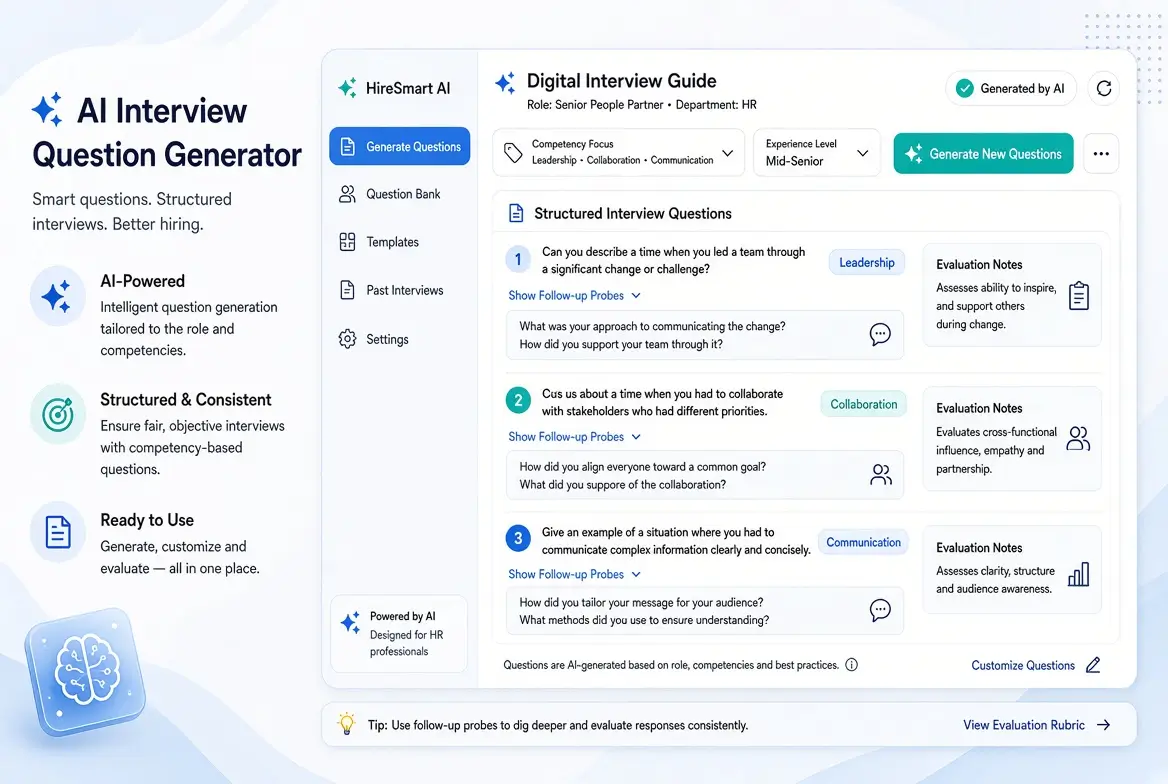
An AI interview question generator for HR helps non-technical teams solve that problem quickly. With the right inputs and prompts, AI can produce structured interview questions, behavioral prompts, situational scenarios, follow-up probes, and evaluation notes in minutes.
This guide shows you how to use AI as a practical interview question generator. Not as a replacement for human judgment, but as a tool for clearer, fairer, and more consistent interviews.
Why Structured Interview Questions Matter
Structured interviews, where candidates are asked similar job-related questions and evaluated against consistent criteria, generally produce better and fairer hiring outcomes than unstructured conversations.
Good interview questions help you:
- Assess real skills and experience
- Compare candidates more consistently
- Reduce reliance on gut feel alone
- Improve collaboration with hiring managers
- Create a clearer record of what was evaluated
AI can accelerate the creation of these questions, but it should not decide who advances.
What AI Can Do Well as an Interview Question Generator
AI is effective at:
- Turning job descriptions into interview questions
- Creating behavioral and situational questions
- Generating follow-up probes
- Building question sets by competency
- Adapting tone and difficulty for different role levels
- Helping standardize interviews across interviewers
AI is less reliable when:
- Questions are disconnected from real role requirements
- Outputs are used without review
- The same generic questions are applied to every role
- Evaluation criteria are missing
Why HR Teams Use AI to Generate Interview Questions
As I previously mentioned, structured interviews are widely recognized as more predictive and fairer than unstructured ones. The challenge for busy HR teams and hiring managers is creating those structured questions for every role.
AI helps by:
- Turning job descriptions into role-specific questions
- Generating behavioral interview questions (STAR-style)
- Creating situational and scenario-based questions
- Building competency-based question sets
- Adding “what to listen for” guidance for interviewers
- Supporting consistent scorecards across candidates
Used well, AI reduces preparation time while improving interview quality.
What Makes a Good AI-Generated Interview Question Set
High-quality output usually includes:
- Questions tied to real job requirements
- A mix of behavioral and situational questions
- Follow-up probes that dig into evidence
- Notes on what strong answers may include
- Clear links to competencies or skills
- Language that stays job-related and legally safer
Generic questions like “What are your strengths?” add little value. Specific, evidence-seeking questions perform better.
How to Use AI as an Interview Question Generator
Step 1: Start from the Role, Not a Blank Prompt
Feed AI the job title, key responsibilities, must-have skills, and seniority level. Better inputs produce better questions.
If your job description needs work first, use:
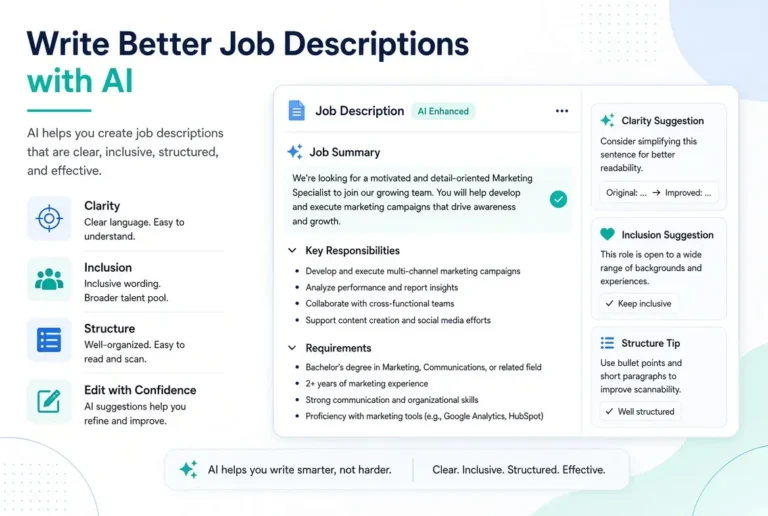
How to Write Better Job Descriptions with AI
Step 2: Generate Questions by Competency
Ask for questions mapped to specific skills or outcomes rather than one long generic list.
Step 3: Add Evaluation Support
Request what a strong answer may include and what weak or vague answers often look like. This helps interviewers score more consistently.
Step 4: Review and Standardize
Edit for relevance and fairness. Use the same core questions across candidates for the same role.
Best AI Prompts to Generate Interview Questions
1. Core Structured Interview Question Generator
Act as an experienced HR interviewer. Generate structured interview questions for this role.

Role title: [Job Title]
Seniority: [Junior / Mid / Senior]
Key responsibilities: [List]
Must-have skills and experience: [List]

Create 8–10 job-relevant questions.
Include a mix of behavioral and situational questions.
Avoid generic questions such as “What are your strengths and weaknesses?”
Make each question specific to the work of this role.
2. Competency-Based Interview Questions
Create a competency-based interview question set for a [Job Title].

Competencies to assess:
[List 4–6 competencies]

For each competency, provide:
- 1 primary question
- 2 follow-up probes
- What a strong answer may include
- One possible red flag in a weak answer

Keep all questions job-related and practical.
3. Behavioral Interview Questions (STAR-Focused)
Generate 8 behavioral interview questions for a [Job Title] using the STAR framework (Situation, Task, Action, Result).

Focus on these areas:
[List skills, challenges, or responsibilities]

Questions should ask candidates to describe real past experiences, not hypothetical opinions.
4. Situational / Scenario Questions
Create situational interview questions for a [Job Title].

Base the scenarios on realistic challenges related to:
[List common role challenges]

For each scenario include:
- The situation
- The main question
- One follow-up question
5. Full Interview Kit for Hiring Managers
Build a simple interview kit for a [Job Title].

Include:
- 8 structured interview questions
- The competency each question assesses
- What to listen for in a strong answer
- 3 job-related red flags to watch for
- Suggested scoring focus (not a final hire recommendation)

Use these role details:
[Paste responsibilities and requirements]
6. Improve Existing Interview Questions
Improve the following interview questions for a [Job Title].

Make them more specific, more structured, and more useful for comparing candidates.
Remove generic or low-value questions.
Keep them fair and job-related.

Current questions:
[Paste]
7. Scorecard Companion Prompt
Create a simple interview scorecard based on these questions and competencies.

Questions and competencies:
[Paste]

For each item include:
- Competency name
- Rating scale (1–5)
- Brief description of what a 1, 3, and 5 look like
Best Practices for AI-Generated Interview Questions
- Anchor every question to a real requirement from the job description
- Use the same core question set for all candidates in the same role
- Combine behavioral and situational questions
- Give interviewers “listen for” notes, not just questions
- Avoid questions that touch protected characteristics
- Review AI output before using it in live interviews
- Continuously refine questions based on what predicts success
Common Mistakes to Avoid
- Asking AI for “good interview questions” with no role context
- Using only soft-skill or personality questions
- Letting each interviewer invent different questions
- Treating AI output as final without review
- Confusing clever questions with predictive questions
Recommended Tools for Non-Technical HR Teams
You can start with general AI assistants:
- ChatGPT
- Claude
- Gemini
These work well as a flexible AI interview question generator for HR when paired with strong prompts. Dedicated generators and ATS features can be added later if your volume justifies them.
For earlier stages of the process, see:
Using AI for Resume Screening (Without Bias)
How This Fits Into a Complete Recruiting System
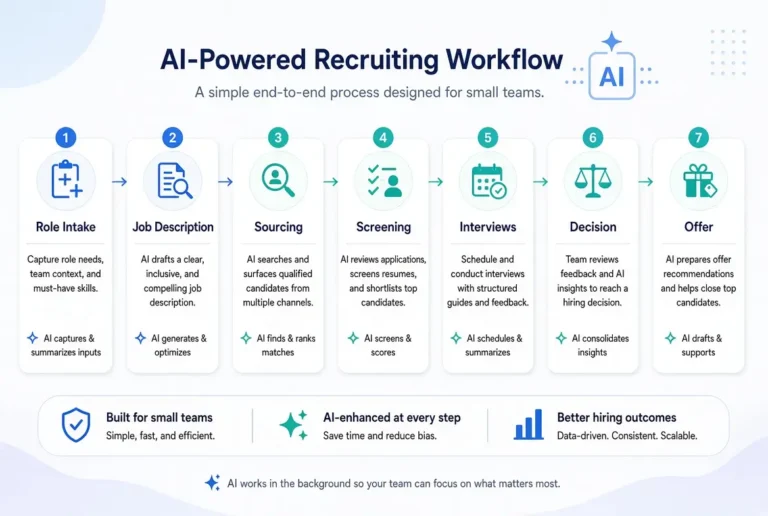
Better interview questions work best when connected to:
- Clear job descriptions
- Bias-aware screening
- Consistent evaluation
- Human decision-making
Related guides in this cluster:
- AI Prompts for Writing Job Descriptions
- Ethical AI in Recruiting – Practical Guidelines
- AI-Powered Recruiting Workflow for Small Teams
Main pillar:
AI for Recruiting and Talent Acquisition
Final Thoughts
An AI interview question generator for HR is most valuable when it helps you build structure quickly. The goal is not to automate interviews. The goal is to make every interview more consistent, more job-relevant, and easier to evaluate.
Start with one open role this week. Paste the responsibilities and must-have skills into a strong prompt, generate a focused question set, review it with the hiring manager, and use the same core questions across candidates. That single improvement often raises interview quality more than adding another tool.
Frequently Asked Questions
It is a way of using AI tools and prompts to create structured, role-specific interview questions, follow-ups, and evaluation notes for hiring teams.
Yes, when you provide clear role context, competencies, and instructions. Weak prompts produce generic questions; strong prompts produce usable interview guides.
For most HR teams, AI is best used to prepare questions and structure. Humans should conduct interviews and make hiring decisions.
Tie questions to job requirements, use consistent questions across candidates, avoid non-job-related topics, and review outputs before use.
Yes. AI can draft simple scorecards and “what good looks like” guidance linked to each question, which supports more consistent evaluation.
No. AI can help prepare questions and structure interviews. Humans should conduct interviews and make hiring decisions.
General tools like ChatGPT, Claude, and Gemini work well when given clear role context and strong prompts.
Using a consistent core set of job-related questions improves fairness and comparability. Follow-ups can still be tailored.
Anchor questions to job requirements, avoid non-relevant personal topics, review for fairness, and apply the same structure across candidates.