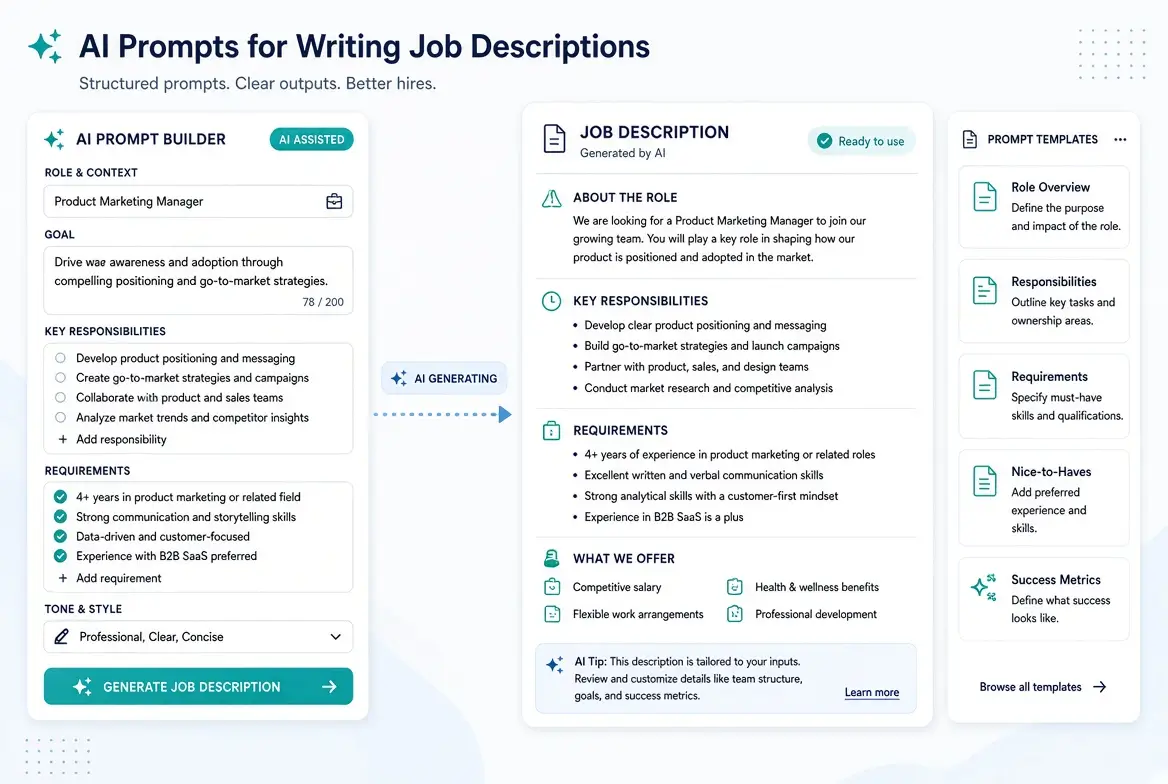
AI Prompts for Writing Job Descriptions (Copy & Paste Guide 2026)
Writing job descriptions is one of the highest-leverage activities in recruiting, and one of the easiest places for non-technical HR professionals to get fast wins with AI.
The challenge is that most people use weak prompts. They type something like “Write a job description for a Marketing Manager” and receive a generic, inflated, jargon-filled draft that still needs heavy editing.
Better prompts produce clearer, more inclusive, and more useful job descriptions on the first try. This guide gives you ready-to-use AI prompts for writing job descriptions, including ChatGPT prompts for job descriptions, Claude-friendly versions, and practical templates you can adapt immediately.
Why Most AI Job Description Prompts Fail
Many people type something like:
“Write a job description for a Sales Manager”
The result is usually generic, inflated, and full of vague language. The AI fills gaps with assumptions because the prompt gave it almost no real information.Better prompts succeed because they include:
- Clear role context
- Real responsibilities
- True must-have requirements
- Explicit instructions about what not to invent
- Desired tone and structure
When you provide these elements, AI becomes a reliable drafting assistant instead of a source of generic content.
Why Prompt Quality Matters
AI does not magically understand your role. It responds to the clarity of your instructions. Strong prompts typically include:
- Role context
- Real responsibilities
- Clear must-have vs nice-to-have requirements
- Desired tone
- Constraints (what not to invent)
When these elements are present, tools like ChatGPT, Claude, and Gemini become reliable drafting assistants rather than generic content generators.
How to Use These Prompts Effectively
- Replace the bracketed sections with your real information.
- Provide specific responsibilities and requirements whenever possible.
- Always review the output for accuracy, tone, and inclusion.
- Never let AI invent requirements, salary, or benefits you did not supply.
- Keep final approval with the hiring manager and HR.
Core Prompt Library: Best AI Prompts for Writing Job Descriptions
1. Full Job Description Generator (Best Starting Prompt)
Act as an experienced HR professional and recruiter. Write a clear, inclusive, and engaging job description.

Role title: [Job Title]
Company type / industry: [e.g., B2B SaaS, healthcare, nonprofit]
Location / work arrangement: [Remote / Hybrid / On-site + details]
Reports to: [Title]
Role purpose: [1–2 sentences on why the role exists]
Key responsibilities: [List 5–8 real responsibilities]
Must-have requirements: [List only true requirements]
Nice-to-have requirements: [List]
Tone: Professional, clear, and welcoming

Structure the job description with:
- Short role summary
- Key responsibilities
- Must-have requirements
- Nice-to-have requirements
- Practical logistics (location, work arrangement)

Do not invent requirements, years of experience, degrees, or benefits I did not provide. Avoid jargon, inflated language, and clichés such as “rockstar” or “ninja.”
2. Turn Rough Notes into a Structured Job Description
I will paste rough notes from a hiring manager. Turn them into a clean, structured job description.

Keep the meaning accurate. Organize the content clearly. Separate must-have and nice-to-have requirements. Improve clarity without adding new requirements.

Rough notes:
[Paste notes]
3. Improve an Existing Job Description
Improve this job description for clarity, structure, and inclusivity.

- Make the language clearer and more concise
- Remove unnecessary jargon
- Separate must-have from nice-to-have requirements if mixed
- Keep the original meaning
- Do not add new requirements

Job description:
[Paste current version]
4. Make a Job Description More Inclusive
Review this job description and rewrite it to improve inclusivity.

Flag and replace gendered, age-coded, or unnecessarily aggressive language.
Keep the role requirements accurate.
Maintain a professional and welcoming tone.

Job description:
[Paste]
5. Separate Must-Haves from Nice-to-Haves
Review this list of requirements for a [Job Title] role.
Separate them into:

1. Genuine must-haves (a candidate cannot do the job without these)
2. Strong preferences (helpful but learnable)
3. Nice-to-haves or aspirational items that should not be listed as required

Requirements:
[Paste list]
6. Write an Outcome-Focused Job Description (First 90 Days)
Write a job description for a [Job Title] that focuses on outcomes rather than only tasks.

Organize part of the description around what success looks like in the first 30, 60, and 90 days.
Keep the language clear and realistic.
Use the following context:

[Paste role details, responsibilities, and requirements]
7. Create a Shorter Job Ad Version
Rewrite this full job description into a shorter job ad (under 400 words) suitable for job boards or LinkedIn.

Keep:
- The core purpose of the role
- Key responsibilities
- True must-have requirements
- Location / work arrangement

Remove unnecessary detail while preserving accuracy.

Full job description:
[Paste]
8. Generate Multiple Tone Variations
Create three versions of this job description with different tones:

1. Professional and straightforward
2. Warm and people-focused
3. Direct and concise

Keep the same requirements and responsibilities in all versions.

Base content:
[Paste]
Advanced Prompting Tips for Better Results
Prompting Best Practices for Better Results:
- Be specific about constraints. Tell the AI what it must not invent.
- Use real responsibilities. Vague inputs produce vague outputs.
- Ask for structure. Clear section requests improve readability.
- Iterate. Follow up with refinement prompts instead of starting over.
- Match your culture. Add guidance about tone when it matters.
Common Mistakes to Avoid When Using AI Prompts for Writing Job Descriptions
These are some of the mistakes I’ve seen most people often make when using AI prompts for writing job descriptions:
- Using one-line prompts with no context
- Accepting the first draft without review
- Allowing AI to add inflated requirements
- Publishing without hiring manager alignment
- Focusing only on keywords instead of clarity
How Better Prompts Improve Recruiting Outcomes
In my experience, better prompts lead to better job descriptions. Better job descriptions improve:
- Candidate quality
- Screening consistency
- Interview focus
- Candidate expectations
This article works best alongside our broader guide:
Writing Better Job Descriptions with AI
And the main pillar:
Using AI for Recruiting and Talent Acquisition
Final Thoughts
You do not need dozens of complicated prompts. You need a small set of reliable templates that force clarity, protect accuracy, and improve inclusion.
Start with the full job description generator prompt. Provide real responsibilities and true must-have requirements. Refine the draft, align with the hiring manager, and save the versions that work. Over time, your prompt library becomes a practical asset for the entire HR team.
Clear prompts produce clearer job descriptions, and clearer job descriptions make every later stage of recruiting easier.
Frequently Asked Questions
ChatGPT, Claude, and Gemini can all perform well when given strong prompts. The quality of the prompt usually matters more than the specific tool.
Yes. All prompts in this guide work with ChatGPT, Claude, Gemini, and similar tools.
AI should create the draft. Humans should refine, validate requirements, and approve the final version.
More specific inputs almost always produce better results. Include real responsibilities and clear constraints.
Yes. AI can help identify and improve exclusionary language, but final responsibility for fairness and accuracy remains with the HR professional.