AI for Recruiting and Talent Acquisition (2026 Guide for Non-Technical HR)
Recruiting remains one of the most time-consuming and high-stakes parts of HR. Writing job descriptions, screening resumes, coordinating interviews, and staying in touch with candidates can quickly overwhelm small teams and non-technical HR professionals.
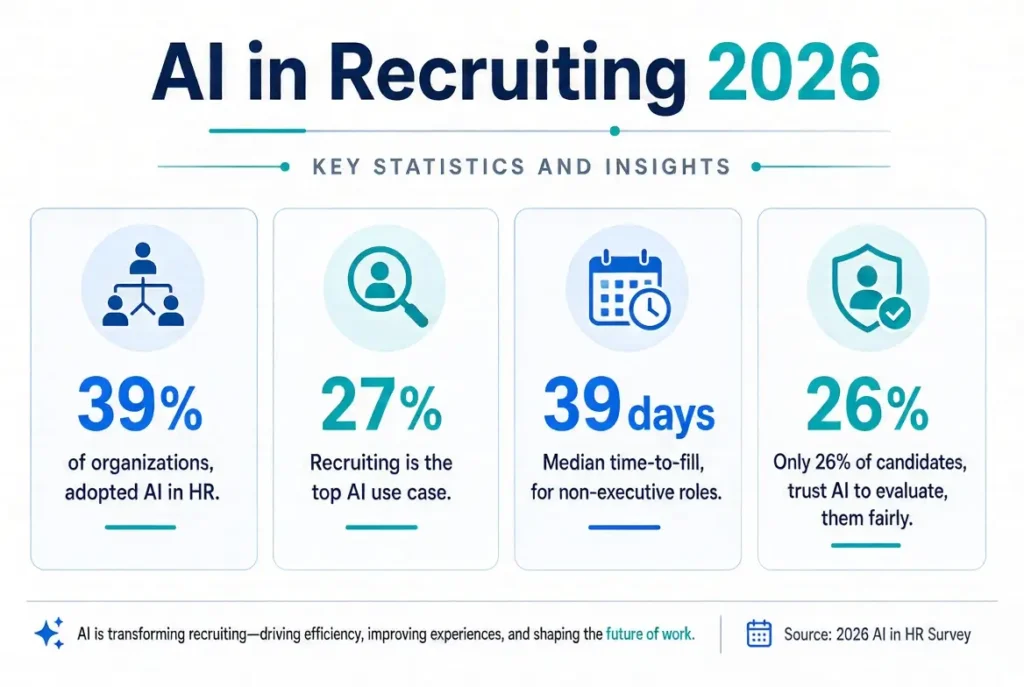
AI is changing this. According to SHRM’s State of AI in HR 2026 report, recruiting is the most common area where organizations apply AI within HR functions (27% of organizations). Overall AI adoption in HR reached 39% by late 2025, up significantly from previous years.
This guide is written for non-technical HR professionals and talent acquisition teams who want practical ways to use AI recruiting tools and AI hiring tools without coding or complex systems. You will learn where AI helps most, where human judgment must stay in control, and how to build a simple, effective AI-powered recruiting approach.
Table of Contents
Why AI Matters in Recruiting Right Now
Hiring is under pressure. Time-to-fill for non-executive roles has improved in some benchmarks (SHRM reported a median of 39 calendar days in recent data), yet many teams still struggle with volume, consistency, and administrative load.
Organizations using AI in hiring frequently report meaningful gains in efficiency and time savings. Some studies show improvements in hiring efficiency and reductions in time spent on repetitive tasks. At the same time, candidate trust remains a concern. Only about 26% of candidates say they trust AI to evaluate them fairly.
The opportunity for non-technical HR is clear: use AI to handle volume and structure, while keeping humans responsible for final decisions and candidate experience.
What AI Can Do Well in Talent Acquisition
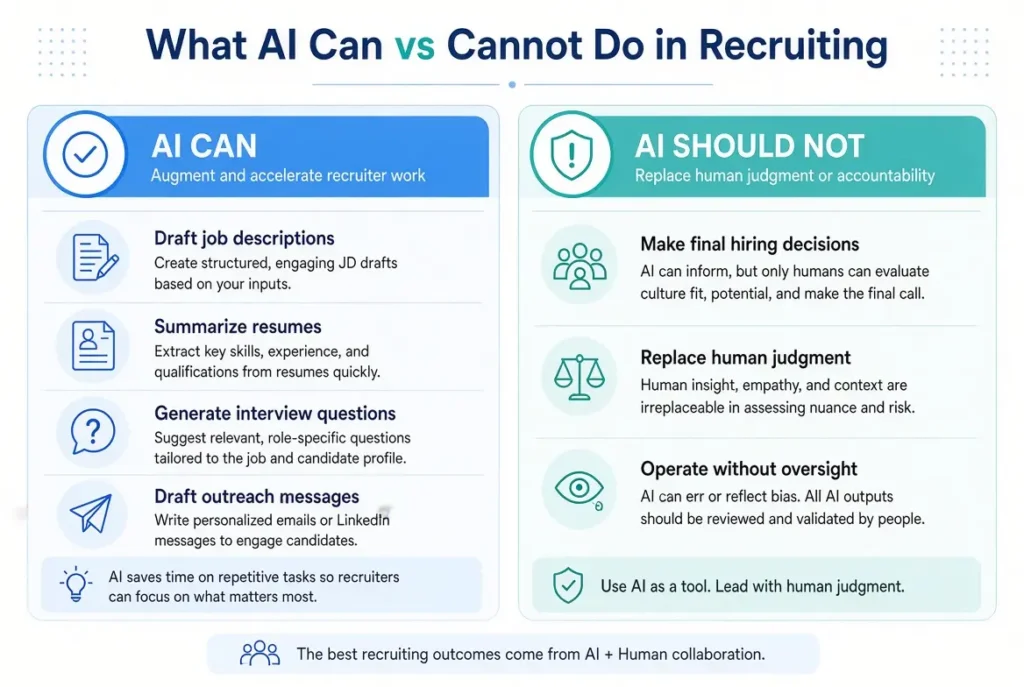
AI is particularly effective for:
- Drafting and refining job descriptions
- Structuring screening criteria
- Summarizing resumes against role requirements
- Generating interview questions
- Drafting personalized outreach and follow-up messages
- Organizing candidate information
- Creating consistent evaluation frameworks
AI is less reliable (and often inappropriate) as the sole decision-maker for who advances or who receives an offer.
Core Areas Where Non-Technical HR Can Use AI
1. Job Descriptions
AI can turn rough notes into clear, structured, and more inclusive job descriptions in minutes. This is one of the highest-ROI starting points for most teams.
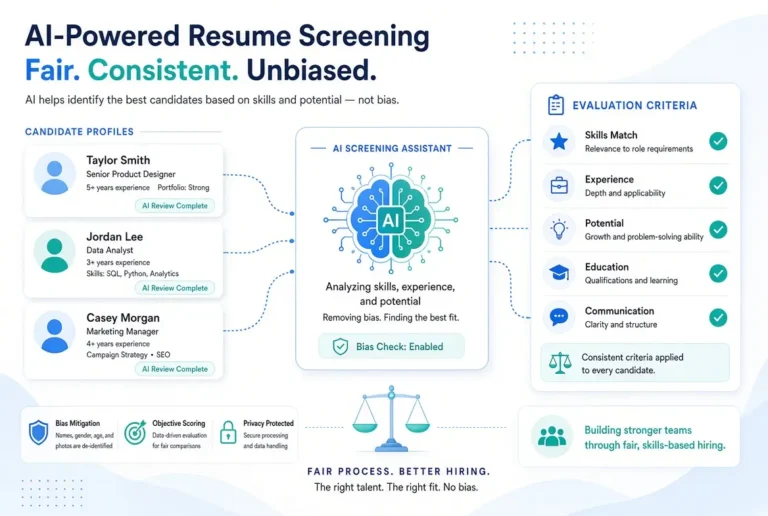
2. Resume Screening Support
AI can help summarize candidates against defined criteria and highlight potential matches. Human review remains essential to avoid bias and catch context that algorithms miss.
3. Interview Preparation
AI can generate structured interview questions tied to competencies and help create consistent scorecards.
4. Candidate Communication
AI speeds up drafting outreach messages, status updates, and follow-ups while still allowing personalization.
5. Process Design
AI can help document recruiting workflows, create checklists, and identify bottlenecks.
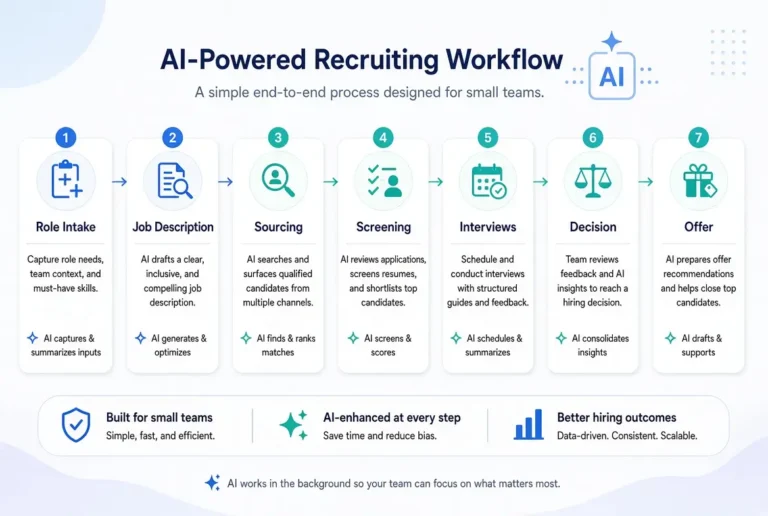
A Practical AI Recruiting Workflow for Non-Technical Teams
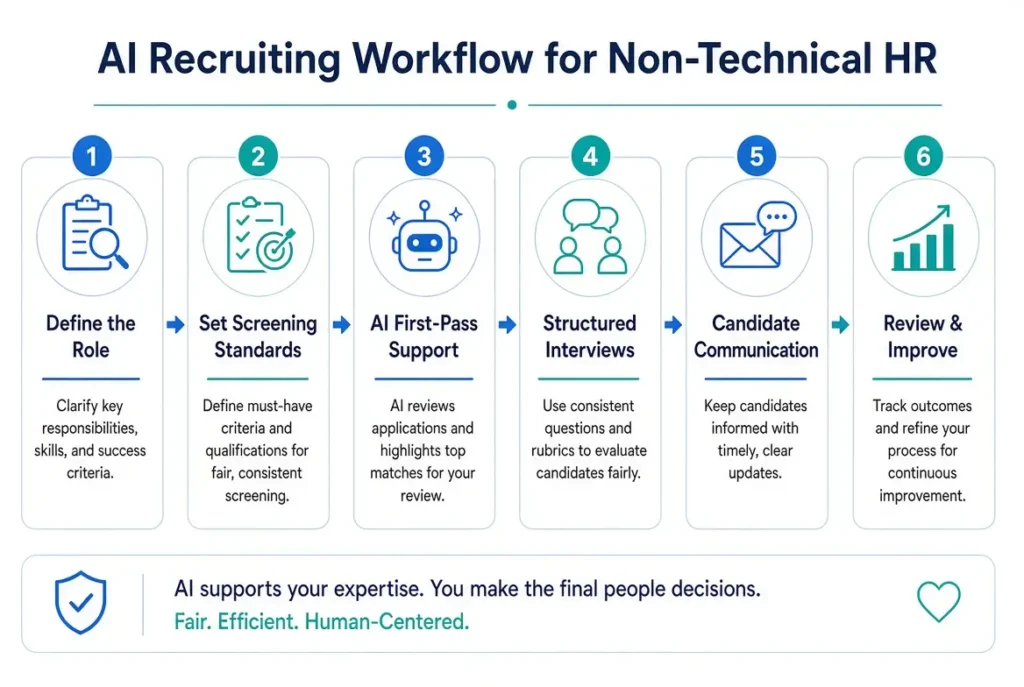
Here is a simple workflow many small and mid-sized teams can adopt:
Practical AI workflow for recruiting teams and small businesses.
- Define the role clearly
Use AI to refine the job description and must-have vs. nice-to-have criteria.
- Set screening standards
Create a short list of objective criteria before looking at candidates.
- Use AI for first-pass support
Ask AI to summarize resumes against those criteria (always review the output).
- Prepare structured interviews
Generate consistent questions and evaluation guides.
- Support communication
Draft outreach and updates with AI, then personalize.
- Review and improve
After each hire, note what worked and refine prompts and criteria
This approach keeps humans in control while reducing repetitive work.
Benefits and Realistic Limitations of AI for Recruiting and Talent Acquisition
Reported benefits of AI in recruiting include:
- Faster early-stage screening and communication
- More consistent job descriptions and interview structures
- Time savings on administrative tasks
- Ability to handle higher application volume
Important limitations:
- Risk of amplifying historical bias if criteria or data are flawed
- Lower candidate trust when AI involvement is not transparent
- Output quality depends heavily on the quality of your prompts and inputs
- AI cannot replace relationship-building or nuanced judgment
Successful teams treat AI as a drafting and structuring assistant, not an autonomous hiring decision system.
Ethical and Practical Guidelines in AI for Recruiting and Talent Acquisition
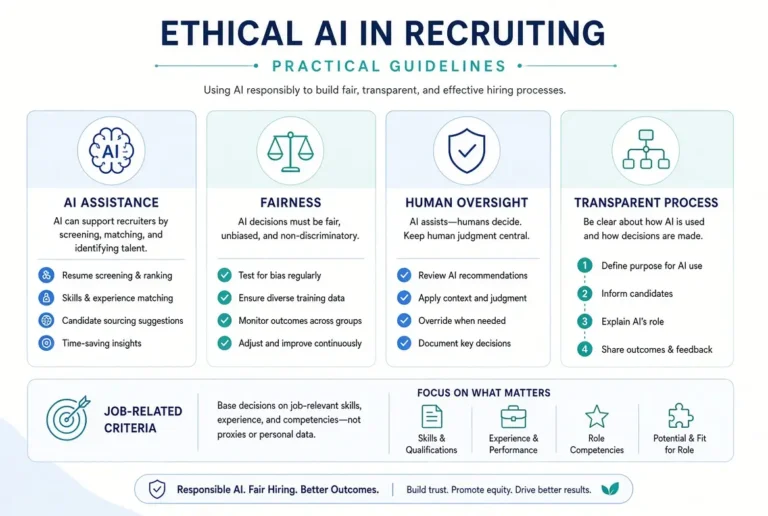
To use AI responsibly in recruiting:
- Keep final advancement and offer decisions with humans
- Define clear, job-related criteria before using AI for screening support
- Review AI outputs for bias and accuracy
- Be transparent with candidates when AI plays a significant role
- Avoid feeding sensitive personal data into public AI tools unnecessarily
- Document your process so it can be audited or improved
These practices protect both candidates and the organization.
How This Pillar Connects to Supporting Guides
This pillar provides the overall framework. The supporting articles go deeper into specific tactics:
- How to Write Better Job Descriptions with AI
- AI Prompts for Writing Job Descriptions
- Using AI for Resume Screening (Without Bias)
- AI Interview Question Generator for HR
- How to Use AI for Candidate Outreach
- AI Tools for Recruiting on a Budget
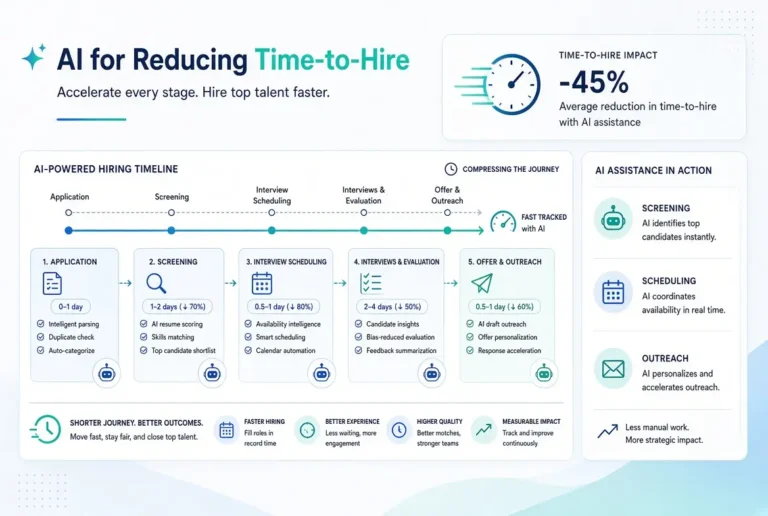
- AI for Reducing Time-to-Hire
- Ethical AI in Recruiting – Practical Guidelines
- AI-Powered Recruiting Workflow for Small Teams
The Evolution of AI in Talent Acquisition: 2026 Landscape
Five years ago, “AI in hiring” often referred to basic keyword filters in applicant tracking systems, which could reject candidates based on specific word choices. That version is gone. What replaced it reads job descriptions, drafts outreach, summarizes interviews, and flags patterns across an entire talent market. Oh, and it does so through a chat box that any recruiter can operate without writing a line of code.
State of the Industry in 2026: The center of gravity has moved from rules-based automation to generative talent intelligence. Systems that produce language and surface insight rather than simply sorting records. 77% of organizations plan to increase their use of AI in hiring in the coming year, which makes adoption a question of sequencing rather than whether.
Mid-market teams are the reason this year reads as a tipping point. Enterprise talent functions had budget for pilots long before the tooling matured. Smaller teams waited for the price and the learning curve to drop. Both have now dropped. The result is a market where a four-person recruiting team can run workflows that previously required a dedicated operations hire.
Candidates’ expectations have evolved, complicating the picture. They expect same-day acknowledgment and a scheduling link, and they are perfectly willing to use their own tools to meet you on equal footing. Recruiter efficiency and candidate expectation are now the same pressure measured from two directions.
The scope is wider than most teams assume. Academic review of the field identifies 11 distinct areas across the recruitment and selection process where AI applications can be applied, from sourcing through onboarding. This guide argues that AI for talent acquisition is most effective when humans remain accountable for decisions. Basically, automation manages volume, but judgment remains human.
Core Terminology: Understanding the AI Recruiting Stack
Most confusion about ai recruiting comes from treating one category of technology as if it were all of them. Six terms cover almost everything a non-technical leader needs to evaluate a vendor, brief a team, or push back on a claim in a sales deck.
Generative AI
A system that produces new content such as a job description, an outreach email, or an interview summary, in response to an instruction you type in plain language.
Predictive AI
A system that scores or ranks what already exists, estimating the likelihood that a candidate matches a role, accepts an offer, or stays past year one.
Prompt Engineering
The practical skill of writing instructions precise enough that a generative tool returns something usable on the first or second attempt, including the context, audience, constraints, and format you want back.
Talent Intelligence
The aggregation of internal hiring data with external labor market signals like compensation, skill supply, and competitor movement to inform where and how you hire rather than simply whom you shortlist.
Automated Screening
Any process that filters, ranks, or routes applicants without a recruiter reading each file, whether driven by rules, scoring models, or structured questions.
Human-in-the-Loop (HITL)
A workflow design in which the system recommends and a named person decides, with the rejection or advancement authority never delegated to the software.
The key distinction in procurement is between generative and predictive AI. Generative output is visible, editable, and wrong in obvious ways. Predictive output is a number, which looks authoritative and hides its reasoning. Teams tend to over-supervise the first and under-supervise the second, when the risk profile runs the other way.
The 7 Functional Types of AI in Recruitment
Vendor categories blur because every platform claims every capability. Sorting your stack by function instead of brand exposes where you have three overlapping licenses and where you have a gap.
1. Sourcing and Screening AI
Searches resume databases, job boards, and professional profiles, then ranks applicants against role requirements. Primary use case: high-volume roles where applicant counts exceed what a recruiter can read.
2. Conversational AI and Chatbots
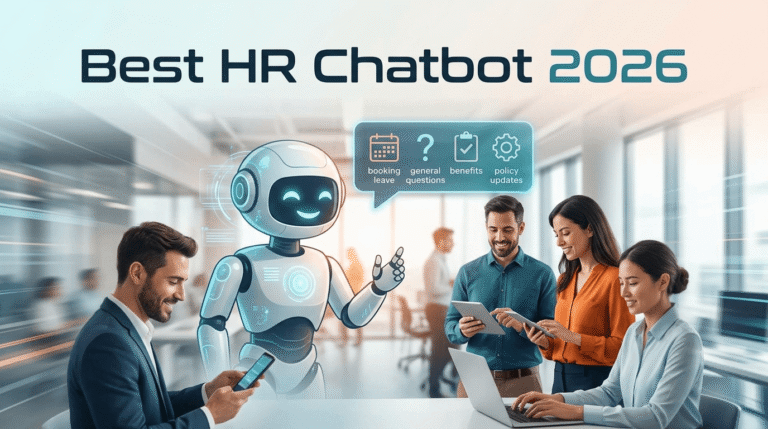
Answers candidate questions, captures screening responses, and maintains contact between application and decision. Primary use case: keeping applicants informed outside business hours.
3. Assessment and Matching AI
Administers structured skills tests or work samples and maps results to role profiles. Primary use case: quality control when resumes are a poor proxy for capability.
4. Scheduling and Workflow Automation
Coordinates calendars across panels, sends reminders, and moves candidates between stages. Primary use case: removing the coordination tax from interview-heavy processes.
5. Predictive Analytics
Models offer acceptance, time-to-fill, source quality, and early attrition. Primary use case: forecasting capacity and defending headcount plans with evidence.
6. Generative AI for Content
Drafts job postings, outreach sequences, interview guides, and rejection notes. Primary use case: producing a usable first version in minutes rather than an afternoon.
7. Interview Intelligence and Assistants
Records, transcribes, and summarizes conversations, surfacing structured notes for hiring managers. Primary use case: consistency and defensibility across interviewers.
The order is not arbitrary. Categories one through four reduce workload; five through seven improve decisions. Teams that buy decision tools before they have fixed their workload problem usually end up with better analytics about a process nobody has time to run properly.
The 30% Rule: Balancing Automation and Human Judgment
The 30% Rule is a planning guideline (not a research finding), designed to address the common recruiter concern: how much of my job is at stake? Roughly three in ten hours of a typical requisition are administrative. Scheduling, formatting, status updates, note transcription, data entry between systems. That portion is the legitimate target for recruitment automation. The remaining seventy percent is assessment, persuasion, negotiation, and managing a hiring manager who changed the spec in week three.
Identifying the automatable thirty is mechanical work. For two weeks, log every task against one test: would a competent stranger produce the same output from the same inputs? Scheduling passes. Reformatting a resume into a submission template passes. Deciding whether an unconventional background is worth a conversation does not. Tasks that pass the stranger test are candidates for tooling; the rest are where your value sits.
Pro Tip: Automation only counts if the reclaimed hours are reassigned on purpose. Write the reallocation into the business case. For example, two additional candidate calls per recruiter per day, or a standing debrief with each hiring manager. Time that is saved but not assigned quietly refills with more administration.
Benchmarking against the threshold keeps the ROI conversation honest. If a tool promises to eliminate work that was never thirty percent of anyone’s week, the savings are theoretical. Measure the administrative share before purchase, measure it again ninety days after, and judge the investment on the gap. A platform that moves administration from thirty percent to eighteen has earned its line item. One that moves it to twenty-eight has bought you a dashboard.
Revolutionizing Sourcing and Resume Screening
This is where most teams start, because it is where volume hurts most, and also where the ethical stakes are highest.
Sourcing
Sourcing tools read structured and unstructured profile data across databases and surface people who match a requirement, including those who did not apply. The gain is coverage.
- Searches talent pools continuously rather than at the moment a requisition opens, resurfacing silver-medal candidates from prior searches
- Drafts and sequences outreach so that a recruiter approves messages instead of composing each one
- Maps skill adjacency, surfacing candidates whose titles differ but whose demonstrated capabilities overlap
- Reveals where competitors are hiring, which is the foundation of any serious competitive talent intelligence practice
Screening
ai resume screening parses applications against role criteria and ranks or clusters them, compressing a first pass that might take a full day into minutes.
- Applies the same criteria to the first application and the four-hundredth, removing fatigue effects that genuinely distort human review
- Extracts skills and experience from inconsistent formats, so a well-qualified candidate with an unusual resume layout is not lost to parsing failure
- Produces an audit trail of why each candidate was ranked where they were
- Surfaces structured signals that feed AI-powered talent intelligence for future requisitions
The caution is permanent. A screening model trained on past hiring decisions inherits the preferences embedded in those decisions, including the ones nobody would defend out loud. Ranking is an input. Rejection stays a human act, performed by someone whose name is attached to it.
Enhancing the Candidate Experience with Conversational AI
The application black hole is a communication failure, not a technology failure, and conversational tools fix it for the simple reason that they never get busy. A chatbot that answers questions about visa sponsorship at 11pm, confirms that an application was received, and offers three interview slots is doing work recruiters always intended to do and rarely had the hours for. Done well, ai candidate engagement is less about charm than reliability. A predictable response, every time, at the speed candidates have come to expect from every other digital interaction in their lives.
“I applied on a Sunday and had a scheduling link before Monday morning. I had assumed I was shouting into a void.”
“The bot told me the salary band without making me ask a human for it. That alone saved me a week of wondering.”
“What I wanted was a straight answer about where I stood. I got one — not from a person, but I got one.”
Personalization at scale is the second gain. The same system can adjust what it tells a warehouse applicant versus a senior engineer, and can keep a passive candidate warm across months rather than letting the relationship lapse between requisitions. That continuity is the connective tissue between hiring and the broader employee experience your brand promises.
39% of candidates are currently leveraging AI tools in the recruiting space. Writing applications, researching employers, and preparing answers. Candidates are not waiting for permission, and a process designed as though they were is already out of date.
AI in the Interview Room: Efficiency vs. Ethics
Interview assistants are the fastest-growing category and the most contested, because the interview is where the hiring decision actually forms. SAP reports that its AI tools improve interview efficiency by 87%, largely through transcription, summarization, and the elimination of post-interview note-writing that interviewers routinely skip.
The same capability is available to the other side of the table. In research from the Institute of Student Employers, 61% of employers identified candidates using AI during interviews without permission as the most common form of misconduct they encountered.
| Benefit | Risk | Mitigation Strategy |
|---|---|---|
| Automatic transcription and structured summaries free interviewers to listen rather than type | Recording without informed consent creates legal exposure and erodes trust | Disclose recording in the invitation, obtain explicit consent, and offer an opt-out path that does not disadvantage the candidate |
| Consistent note capture makes panel debriefs comparable and defensible | Summaries can flatten nuance or over-weight fluent speakers | Require interviewers to confirm or correct the summary within 24 hours; treat the transcript, not the summary, as the record |
| Scoring prompts reduce drift between interviewers | Candidates use undisclosed AI assistance, so you assess the tool rather than the person | State your AI policy in writing before the interview and design at least one live, improvisational component |
The symmetry principle: whatever latitude you grant yourself, grant the candidate, or explain plainly why not. A policy that permits recruiters to summarize with AI while treating candidate use as cheating will not survive contact with an informed applicant pool.
Clear rules outperform detection. Tell candidates which tools are acceptable at which stage, and assess accordingly.
Generative AI for Recruiting Content and Workflows
Content is the lowest-risk entry point into generative ai recruiting, because every output is visible, editable, and reviewed by a human before it reaches anyone. Nothing is decided; something is drafted.
Content
Job descriptions are the obvious first target. A generative tool can produce a posting from a role brief, strip out the gendered and credential-inflating language that narrows applicant pools, and structure it for the search terms candidates actually type. Outreach follows the same pattern. A recruiter supplies the candidate context and the hook, the model supplies the draft, and the recruiter supplies the final voice.
Strategy
The same tools summarize market conditions such as where skills cluster, which titles are churning, what compensation is moving. This works as a briefing input for hiring managers, not as a source of fact. Anything numerical that comes out of a general-purpose model needs verification against a system of record before it enters a business case.
Workflow
The transformation is narrower than the discourse suggests. Analysis from Indeed found that only 1% of job skills are expected to be fully transformed by generative AI, with the vast majority of skills affected partially or not at all. That figure is the best available argument against both panic and over-investment. Generative tools reshape how tasks get done far more often than they eliminate the role performing them. Build workflows on that assumption; draft generated, human edited, human sent, and your process stays defensible even as the tooling changes underneath it.
Selecting the Right AI Recruiting Platform
Evaluate ai hiring software against the function it fills in your stack, not against the demo. A checklist keeps sales conversations anchored.
Must-have features in AI for Recruiting and Talent Acquisition:
Bidirectional ATS integration
Writes back to your system of record, not just reads from it
Explainable scoring
Every ranking comes with the factors that produced it, in language a hiring manager can repeat to a candidate
Configurable human checkpoints
You choose which stages require sign-off, and the system cannot be configured to auto-reject
Documented bias testing
Regular adverse impact analysis, with results you can request, not just a policy page claiming fairness
Audit logging
Who saw what, when, and what action followed
Data residency and retention controls
Candidate data deleted on schedule and stored where your counsel expects
Accessibility compliance
Tested with screen readers and alternative input methods
Exportable data
Your pipeline history leaves with you if the contract ends
Integration strategy decides whether any of this matters. A tool that requires recruiters to work in a second interface will be abandoned within a quarter regardless of its capabilities. Insist on a pilot that runs inside live requisitions, not a sandbox, and measure adoption weekly. If fewer than half your recruiters use it unprompted by week six, the problem is the workflow fit, not training.
Market leaders differ mainly in where they sit relative to your ATS. Embedded modules from your existing vendor, or specialist platforms that layer on top. Embedded options integrate cleanly and move slowly. Specialists move fast and create integration debt. Choose based on how much engineering support you can realistically command, which for most non-technical teams means very little.
The Human Future: Which 3 Jobs Will Survive AI?
Automation removes tasks, and tasks are what junior coordinator roles are made of. The roles that strengthen are the ones built on judgment that cannot be derived from historical data.
The Strategic Talent Advisor
This is the recruiter who tells a hiring manager that the role as written cannot be filled at that salary in that market, and is believed. The advisory function depends on reading organizational politics, understanding what a leader actually needs versus what they requested, and making a recommendation that carries professional risk. Models can supply the market data that supports the argument; they cannot hold the conversation where a VP is told no.
The Candidate Experience Specialist
Senior candidates leave processes for reasons that never appear in a pipeline report. A careless comment, a delay that signaled indifference, a competing offer handled with more warmth. This role owns the moments where a hire is won or lost. The closing call, the counteroffer conversation, the rebuild of trust after a process goes wrong. Empathy here is not a soft skill. It is the mechanism by which an acceptance happens.
The AI Ethicist and Compliance Officer
Someone has to own what the systems do. That means auditing screening outcomes for adverse impact, maintaining the documentation regulators will request, setting the disclosure policy for interviews, and deciding which use cases are off-limits regardless of efficiency. The work is accountability, and accountability cannot be assigned to software.
What unites all three is that each requires a person willing to be answerable for a decision made under uncertainty.
Key Takeaways for TA Leaders
- AI augments recruiters; it does not replace them. Every productive deployment keeps a named human accountable for advancement and rejection decisions. With the system recommending rather than deciding. Teams that remove the human checkpoint to save a few more minutes are trading efficiency for legal and reputational exposure they cannot price.
- Use the 30% Rule as your administrative benchmark. Roughly three in ten hours of a typical requisition are administrative work that passes the “competent stranger” test. Scheduling, formatting, status updates, data transfer. Measure that share before you buy anything, measure it again ninety days later, and judge the tool on the gap.
- Reclaimed time must be reassigned on purpose or it disappears. Write the reallocation into the business case: specific candidate conversations, specific hiring manager debriefs. Unassigned savings refill with new administration within a quarter.
- Screen for bias before you screen for features. Demand documented adverse impact testing, explainable scoring, and exportable audit logs. A vendor who cannot show you how a ranking was produced cannot help you defend it to a regulator, a candidate, or your own general counsel.
- Set a symmetric AI policy for interviews. State in writing what you use, what candidates may use, and at which stage. Clear rules communicated in advance outperform detection tools and preserve the trust that closing offers depends on.
- Invest in AI literacy now, not after procurement. Prompt-writing is the recruiting skill with the fastest return and the lowest barrier, and it requires no technical background. A team that can brief a model precisely will outperform a better-funded team working the same tools by guesswork.
Mastering the Non-Tech AI Transition
The shift from manual to AI-enhanced recruiting is less dramatic than the market noise suggests and more demanding than the vendor demos imply. Nothing about the fundamentals has changed. oles still need defining, candidates still need persuading, hiring managers still need managing. What has changed is that the administrative substrate underneath all of it (the scheduling, the formatting, the note-taking, the status chasing) no longer requires a person. That is the whole of the opportunity, and it is substantial enough without inflation.
The barrier for most talent teams is not capability. It is vocabulary. Technology that is explained in terms of model architectures and training corpora is unusable by the people whose workflows it is supposed to improve, and that gap is where bad procurement decisions get made. Education for non-technical staff has to start where the work starts: this task, this tool, this output, this check.
Our Recommendation: Where to Begin
Prompt writing is the place to begin, because the feedback loop is immediate and the cost of a bad attempt is zero. Take a job description you wrote last month, ask a generative tool to produce it from the same brief, and compare. Then refine the instruction and do it again. Within a week of that practice, most recruiters can produce usable first drafts in a fraction of the time, and, more usefully, can tell when the output is wrong.
The Non-Tech AI is designed for this transition: offering plain-language training that treats AI as a practical workflow skill, not a complex computer science subject. Start with one workflow, build genuine fluency, and expand from there. Recruiters who thrive will be those who learn to direct these tools early, using the time saved to focus on conversations that close candidates.
Getting Started This Week
You do not need new software to begin. Many non-technical HR professionals start with free tools such as ChatGPT, Claude, or Gemini combined with their existing ATS or spreadsheets.
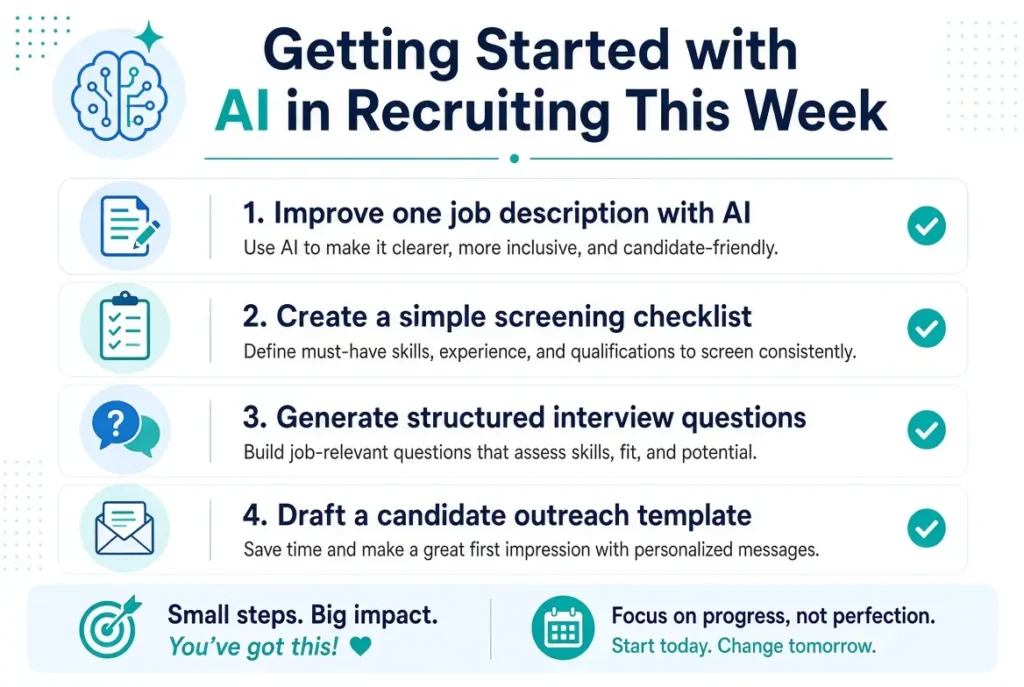
Suggested first actions:
- Take one open role and improve the job description with AI.
- Create a simple screening checklist.
- Generate a set of structured interview questions.
- Draft one outreach message template and refine it.
Small, consistent experiments build confidence faster than large technology projects.
Final Thoughts
AI for recruiting and talent acquisition works best when it reduces friction without removing human judgment. Non-technical HR professionals who learn to direct AI clearly through good prompts, clear criteria, and consistent review, can hire more efficiently while maintaining fairness and candidate experience.
Start with one high-volume or high-friction part of your process. Use AI to create structure and first drafts, then apply your expertise to refine and decide. That combination is where most of the real value sits in 2026.
Frequently Asked Questions
No. AI is primarily reducing administrative load. Human judgment, relationship skills, and final decision-making remain essential.
Yes. Small teams often see the fastest gains because they feel the pain of volume and repetitive work most acutely.
Begin with job description writing and interview question generation which are areas with lower risk, before moving into screening support.
It can help enforce consistent criteria, but it can also amplify existing bias if not carefully designed and reviewed. Human oversight is required.
Not to start. General AI tools plus clear processes are enough for many non-technical teams to see meaningful improvement.