AI-Powered Recruiting Workflow for Small Teams (2026 Guide)
Small teams rarely lack urgency. They lack bandwidth.
When one HR generalist, office manager, or founder is handling hiring on top of everything else, the process breaks in predictable places: unclear role intake, slow screening, messy outreach, scheduling delays, and inconsistent decisions.
An AI-powered recruiting workflow for small teams solves that by assigning AI to repeatable work and keeping humans responsible for judgment. You do not need an enterprise talent acquisition stack. You need a clear sequence, a few practical tools, and consistent checkpoints.
This guide gives you an end-to-end workflow you can run with a lean team.
What a Good Small-Team Recruiting Workflow Looks Like
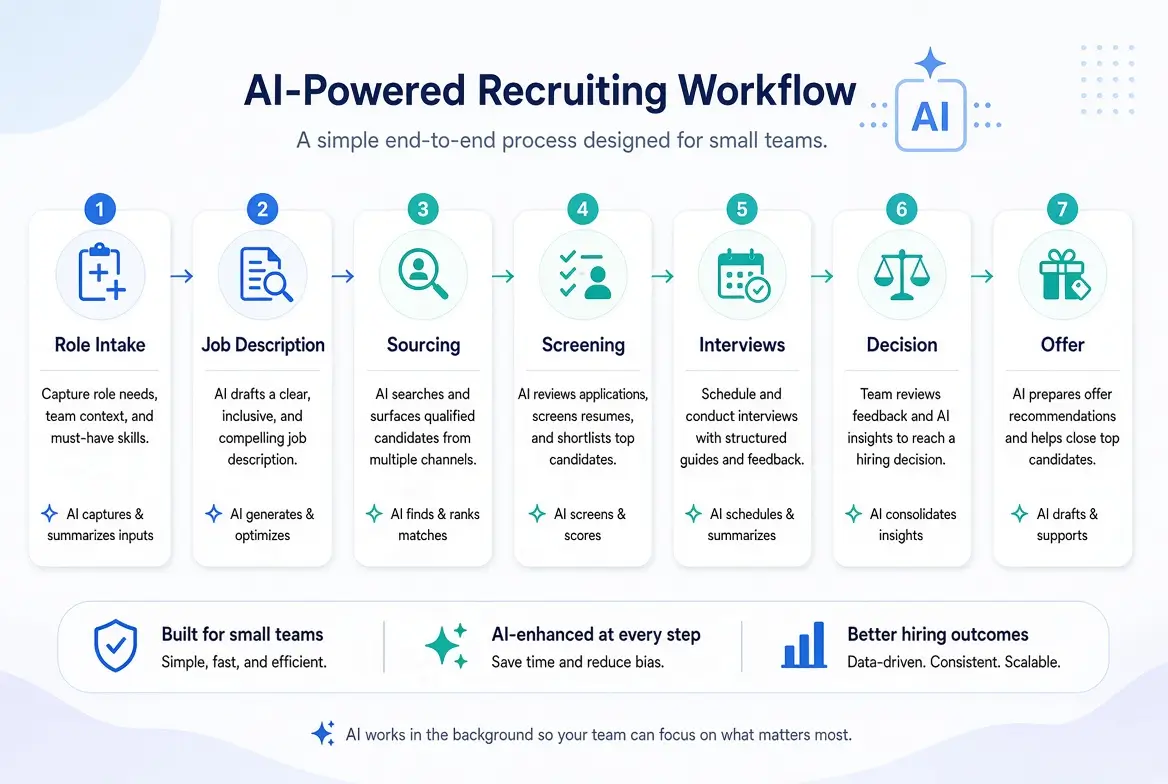
A practical workflow has seven stages:
- Role intake and scorecard
- Job description and posting
- Sourcing and outreach
- Application screening
- Interview preparation and scheduling
- Evaluation and decision
- Offer and handoff
AI can support every stage. Humans should own every advancement and rejection decision.
Stage 1: Role Intake and Scorecard
Start before you write the job post.
Capture:
- Business problem the role solves
- Must-have skills and experience
- Nice-to-haves
- Success metrics for the first 90 days
- Deal-breakers
AI help: Turn rough hiring-manager notes into a structured scorecard.
Human checkpoint: Confirm must-haves are truly required and job-related.
Related foundation:
How to Write Job Adverts with AI
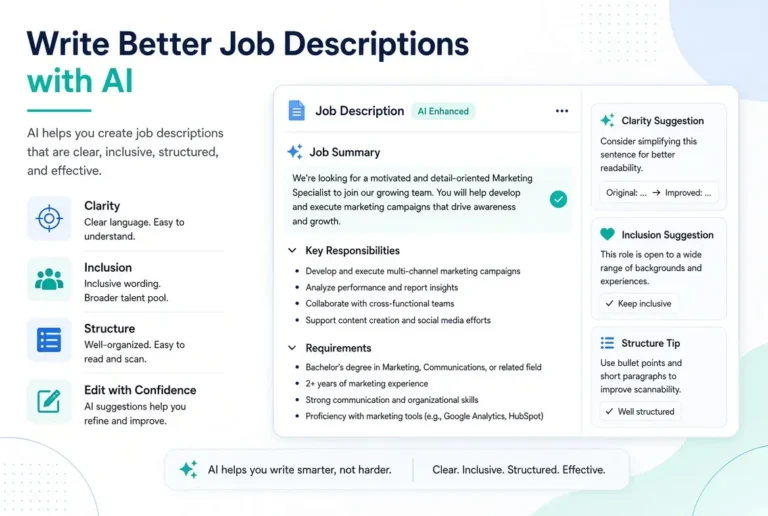
Stage 2: Job Description and Posting
Use the scorecard to draft a clear, inclusive job description. Keep requirements tight. Avoid prestige language that filters out strong candidates for no performance reason.
AI help: Draft the JD, refine tone, and generate posting variations.
Human checkpoint: Edit for accuracy, compensation clarity, and fairness.
Prompt support:
Prompt Library for Generating Job Descriptions
Stage 3: Sourcing and Candidate Outreach
If inbound volume is low, source proactively. If inbound is strong, still keep a light outbound motion for hard-to-fill roles.
AI help:
- Draft outreach messages
- Create follow-up sequences
- Suggest search angles from the scorecard
Human checkpoint:
- Add one real personalization detail
- Review before sending
- Stop sequences on opt-out or clear “no”
Outreach method:
AI Outreach Tools for HR
Stage 4: Application Screening
This is usually the highest-ROI stage for small teams drowning in applications.
AI help: Summarize resumes against must-have criteria and flag gaps.
Human checkpoint:
- Review top matches
- Spot-check borderline and non-traditional profiles
- Make all advance/reject decisions
Bias-aware method:
Bias-Free AI for Resume Screening
Ethical guardrails:
Ethical Guidelines in AI for Recruiting
Stage 5: Interview Preparation and Scheduling
Do not invent questions on the day of the interview. Prepare a structured set and send a booking link as soon as a candidate advances.
AI help:
- Generate behavioral and situational questions by competency
- Draft interviewer kits and scorecard prompts
Operational help:
- Self-serve scheduling links
- Automatic reminders
Interview support:
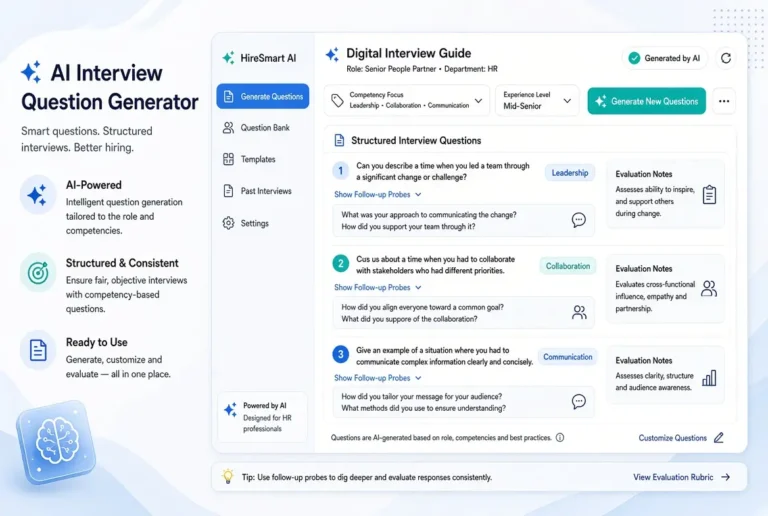
Generate Interview Questions Using AI
Stage 6: Evaluation and Decision
Consistency matters more than clever conversation.
Use:
- The same core questions across candidates
- A shared scorecard
- Fast debriefs
AI help: Summarize notes, organize feedback themes, and prepare comparison tables.
Human checkpoint: Hiring decision remains with people, not the model.
Stage 7: Offer and Handoff
Once the decision is made, move quickly and cleanly.
AI help: Draft offer email language, onboarding checklists, and internal announcements.
Human checkpoint: Final compensation, start date, and candidate communication.
The Small-Team Operating Model
Our recommendation is to use this simple split of work:
| Task type | AI role | Human role |
|---|---|---|
| Drafting JD, outreach, questions | Generate first draft | Edit and approve |
| Screening summaries | Organize against criteria | Decide who advances |
| Scheduling | Support with links/reminders | Set availability rules |
| Interviews | Prepare structure | Conduct and evaluate |
| Final decision | Summarize feedback | Make the call |
A Lightweight Tool Stack for Small Teams
You can run this workflow without expensive software.
Minimum viable stack
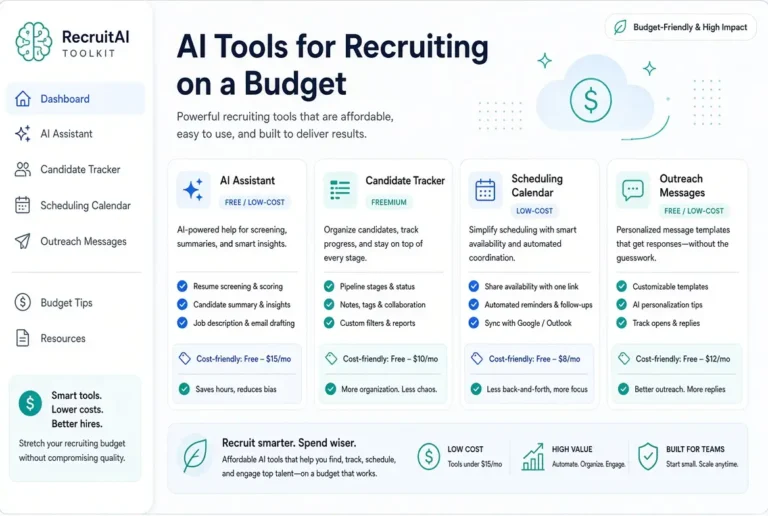
- One AI assistant (ChatGPT, Claude, or Gemini)
- A simple tracker (free/low-cost ATS, Notion, or spreadsheet)
- Calendar booking link
- Shared scorecard template
Add later only if needed
- Sourcing tool for hard-to-fill roles
- Contact data credits
- Light automation between forms, sheets, and email
Budget guidance:
AI Recruiting Tools for Small Teams
30-Day Implementation Plan
Week 1: Stabilize the process
- Pick one open role
- Build the scorecard
- Standardize prompts for JD, screening, outreach, and interviews
- Set a single candidate tracker
Week 2: Compress the top of funnel
- Publish a stronger JD
- Use AI-assisted screening with human review
- Contact promising candidates faster
Week 3: Fix interview operations
- Create structured interview kits
- Turn on self-serve scheduling
- Require scorecards after each interview
Week 4: Measure and refine
- Track days to shortlist
- Track days to first interview
- Track overall time-to-hire
- Improve the bottleneck only
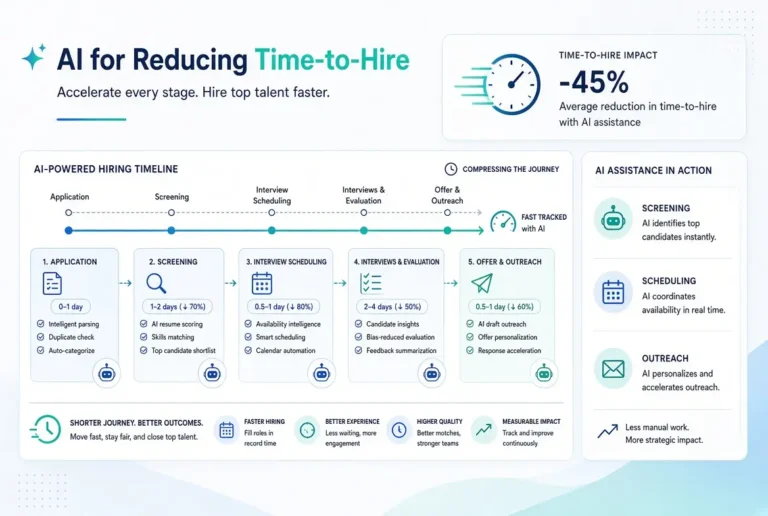
Here is a speed framework that you can use:
AI for Faster Hiring
Common Failure Points in Small-Team AI Hiring
- Starting with tools instead of a scorecard
- Letting AI auto-reject candidates
- Sending generic outreach at volume
- Skipping structured interviews
- Measuring speed without quality checks
- Using too many disconnected apps
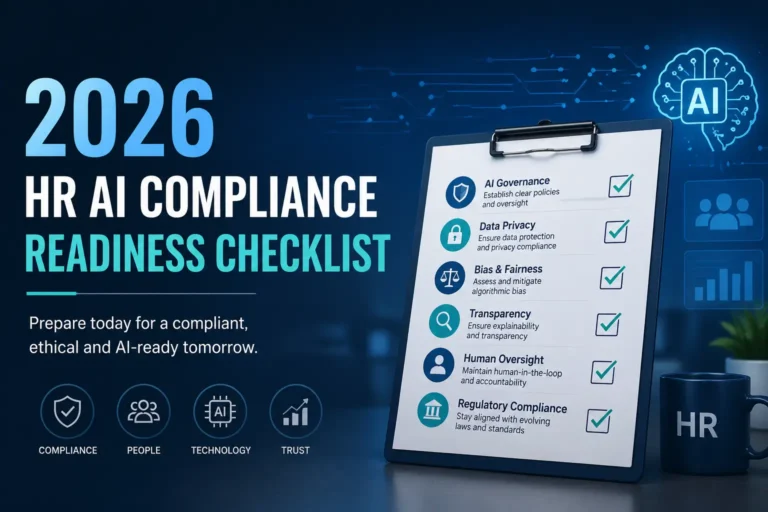
Quality and Ethics Built Into the Workflow
A fast workflow is only useful if it stays fair and defensible.
Build these controls into daily work:
- Job-related criteria before AI use
- Human review before rejection or advancement
- Consistent interview structure
- Clear candidate communication
- Basic outcome review after each hire cycle
How This Fits the Full Recruiting System
This workflow is the practical operating layer for everything in the cluster:
- Better job descriptions
- Bias-aware screening
- Stronger outreach
- Structured interviews
- Lean tooling
- Faster cycle times
- Ethical oversight
Main pillar:
AI to Recruit and Hire Talent
Final Thoughts
An AI-powered recruiting workflow for small teams is not a fully autonomous hiring machine. It is a disciplined process where AI removes administrative drag and people keep control of judgment.
Start with one role. Define the scorecard. Use AI to draft and summarize. Keep humans at every decision gate. Measure cycle time and quality together.
If you do that consistently, small teams can hire with more speed, more structure, and less chaos. Without needing a large recruiting department.
Frequently Asked Questions
It is an end-to-end hiring process where AI supports drafting, screening support, outreach, and coordination, while humans remain responsible for decisions.
Yes. Many solo HR generalists and founders can run this model with one AI assistant, a simple tracker, and structured templates.
Usually screening support or scheduling, depending on which creates the biggest delay.
Not always at the very beginning. A clean tracker can work for low volume. As hiring increases, a lightweight ATS becomes more valuable.
Use clear scorecards, structured interviews, human review before decisions, and post-hire quality checks.
No. It works for any small or lean team that needs consistent hiring without enterprise complexity.